Xiaomi's World Model Demo Is a Cloud Simulation. Tesla's Reality View Runs in the Car.
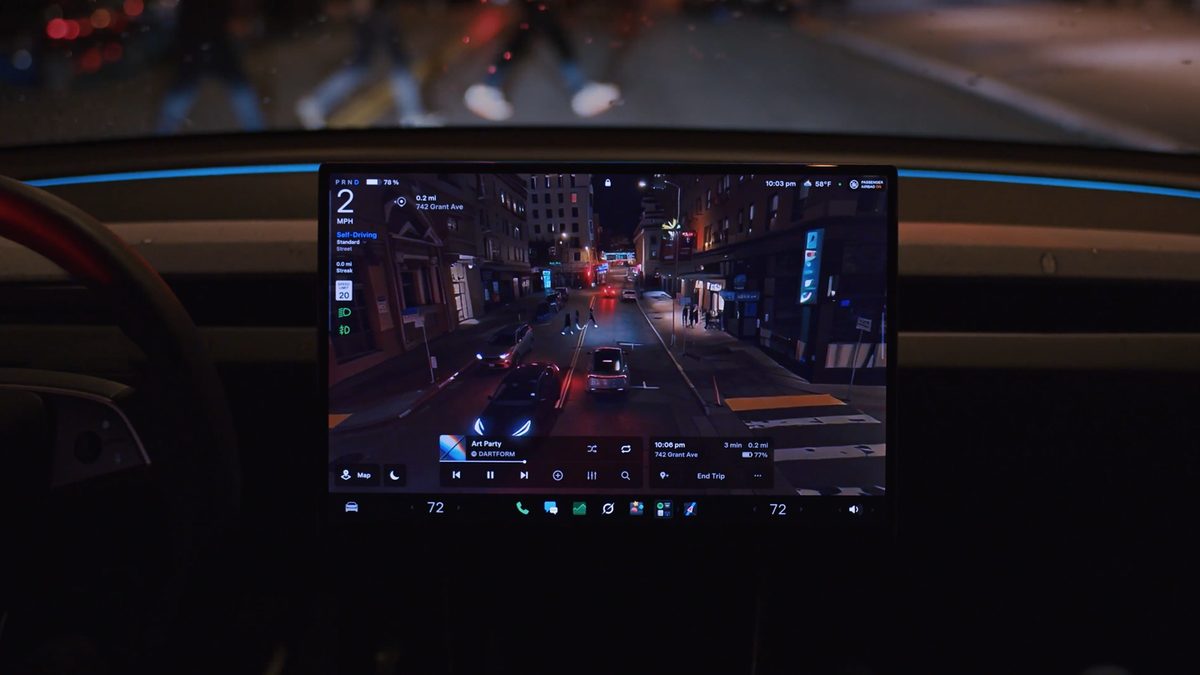
Xiaomi's world-model paper predates Tesla's FSD v15 rollout by three weeks. The demos look alike; the machines behind them do not.
Two driving demos that look alike landed a week apart, and the internet called the second one a copy. The dates say otherwise. Xiaomi's World Model 2.0 paper was submitted to arXiv on November 1; Tesla began pushing FSD v15 on November 21. Xiaomi's first world model dates to May. Whatever the resemblance, one did not copy the other in a week — the work predates the rollout it supposedly copied.
The resemblance is real, and so is the difference. Tesla's Reality View is a live display rendered inside the car: a generative view from a virtual camera above the car, showing the driver what the system plans to do, rebuilt 36 times a second on the car's own AI4 chip. Xiaomi's demo is a cloud simulation: a generated overhead view built offline from recorded test-car data, shown next to the real camera footage it was built from. One is a dashboard. The other is a practice ground.
FSD v15 began rolling out on November 21 — version 15.0.1, software 2026.38.6.11 — with a wide release due in December with the Holiday update. Reality View replaces the old schematic display with a live render from a virtual camera above the car, so the driver sees what the system plans to do in photographic form. The render is built by a roughly 1-billion-parameter diffusion model working from the same vision features that feed the roughly 3-billion-parameter driving model: eight images at 36 frames a second, on half a TRIP — one AI4 accelerator — in 8-bit integer. Tesla AI chief Ashok Elluswamy called the approach “pixels-in-pixels-out.” Tesla says the new version handles safety-critical cases 25 times better than the last. The catch, for now, is latency: the view trails reality by roughly half a second to a second, and Musk says a cut of about 35 percent is coming. It runs on HW4 only, and Musk has said a tap-to-drive point release is a week or two away.
The copycat charge collapses on dates alone. Xiaomi released its first world model in May 2026, a joint reconstruction-and-generation framework built around WorldRec and WorldGen. The 2.0 paper was submitted on November 1, twenty days before Tesla began pushing v15. Xiaomi formally released 2.0 on November 27, the same day its demo clips appeared. The demo was not built in response to v15; the paper describing it was written before v15 reached a single car.
The paper describes a simulator, not a screen. World Model 2.0 is built on Wan2.2-5B, an open-source video-generation model — Xiaomi kept its architecture, weights and video compressor and built on top. Training used 12.6 million clips: 5.4 million driving, 3.6 million robot and 3.6 million general video, plus a small physical-causal subset; an AI model, Qwen3.8, wrote a fresh text description for every clip. Training ran in three stages: general motion from single-camera video, then one-to-seven-camera views with controls such as camera pose and road layout, then distillation down to two denoising steps per chunk. Cross-camera links and time flow are handled separately, and gated linear attention compresses older frames into a compact running memory instead of storing them all.
The reconstruction half, WorldRec 2.0, turns multi-camera footage plus depth into a 3D copy of the street made of Gaussians — small translucent 3D blobs — in a single forward pass. Static scenery and moving objects get separate splat sets, so cars can move while the road stays fixed, and the scene can be rendered from camera angles the test car never had. Those renderings feed the video generator as world control, alongside the detected layout of cars, lanes and lights. Xiaomi has not detailed the exact recipe for the demo's exterior view beyond these components.
The demo stacks three views of the same street: the sensor detections shown on the car's existing screen on top, the AI-generated view from above in the middle, and the real front camera at the bottom. Two scenes: waiting at a red light, and driving through an intersection. The generated panel is an overhead reconstruction — vehicles as smooth, simplified shapes on a uniform road surface, without the texture, signage and clutter of a real camera frame. And the comparison the video invites cannot actually be made: the generated panel looks down from above while the real footage looks forward from the dashcam. Different viewpoints, so there is no pixel-for-pixel check against reality. Xiaomi said the middle view was generated from test-car data. It never called the clip real-time, and never said this view would appear on owners' screens.
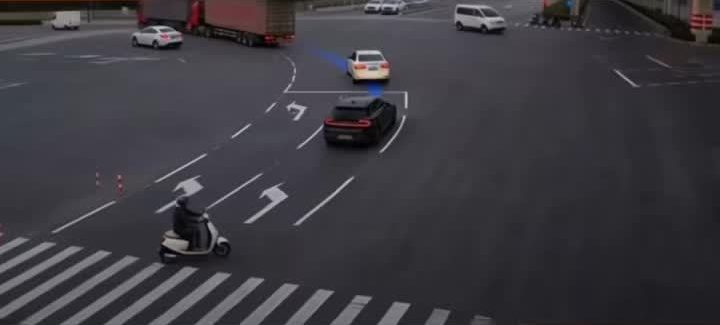
The paper's comparison table does tick “real-time” for 2.0 — but the paper defines real-time as each generation step finishing within the simulated step's time budget, a simulator's definition, not a dashboard's. Its speed figures are measured for simulation: on a single Nvidia H20 datacenter GPU, generating seven camera views takes 1.742 seconds per two-latent-frame chunk, or 1.148 latent frames a second. Latent frames are the model's compressed representation, not finished video frames. Xiaomi gave no in-car timing for the demo's exterior view.
Look past the pictures and the two systems are built in opposite ways. That is the point of a widely shared post on X by Tesla commentator Ray (@ray4tesla), and the technical record backs up the contrast. Xiaomi's demo first builds a predefined 3D representation of the surroundings — WorldRec 2.0 reconstructs the street as static and dynamic Gaussians in a single forward pass — and then a generative module fills in the visual details on top of that scaffold, with the reconstruction doing the heavy lifting, in Ray's account. Tesla's Reality View does the reverse: it is end-to-end visual generation, turning the vision encoder's features directly into pixels through a diffusion model, with no explicit 3D scene model in between. Both aim at lifelike driving scenes. The route to them is fundamentally different.
Where the model is meant to prove itself is in closed-loop simulation, and the paper's numbers there are strong. In 1,000 test scenarios, the world-model-trained driver had a 0.4 percent collision rate against 1.2 percent for the paper's end-to-end baseline, and completed 96.3 percent of scenarios against 95.2 percent. In one intersection example, it adjusted speed four seconds before a merging vehicle reached the crossing point; the baseline braked too late and crashed. The paper also reports that six versions of its driving software ranked the same in the simulator on risky lane changes and late braking as they did in real-vehicle tests — the simulator's judgments track reality.
The clips circulated on X on November 28, and the reaction was not kind. One widely shared post by John Ee called them “sad copies of Tesla's V15” and said XPeng and Xiaomi “has no sliver of embarrassment.” The post also named XPeng; XPeng's own world model, WorldGPT, was announced November 24 and is a separate project, not part of this demo. The charge reads as a verdict on the clips. The dates say it is aimed at the wrong target.
Xiaomi does have a world model going into cars — just not on a screen. Its HAD 1.20 driver-assist update, rolling out to its SkyNomad SUVs from November 27, adds what Xiaomi calls a causal chain and an in-car world model: the software remembers the past 20 seconds of traffic and predicts the next six, by the company's account. Xiaomi mentioned no on-screen display for it.
The comparison still favors Tesla, on the three things that decide this race. Data: Tesla trains on production-fleet driving data at a scale no rival matches, and Musk says Tesla has run a near-pixel-perfect world model in the cloud for about a year, mainly to generate synthetic training data — the in-car Reality View is a much smaller version of it. Architecture: Tesla runs one shared vision encoder across FSD, Robotaxi and Optimus, with a diffusion model rendering the view in the car. Compute: Reality View runs on the car's own AI4 chip at 36 frames a second; Xiaomi's showcase was rendered in the cloud on a datacenter H20, at about one latent frame a second for seven views. A simulator that trains cars in the cloud is a real product — but it is not the same product as a live view rendered in the car.
The paper's figures show the model succeeding; it publishes no failure cases, and a two-clip demo cannot show how it handles rare, messy edge cases. The clip is a window into the practice ground for Xiaomi's driving AI. The next test is whether Xiaomi can shrink such a model to run in the car.