ETH Zurich's humanoid climbs ladders and vaults walls with a single controller
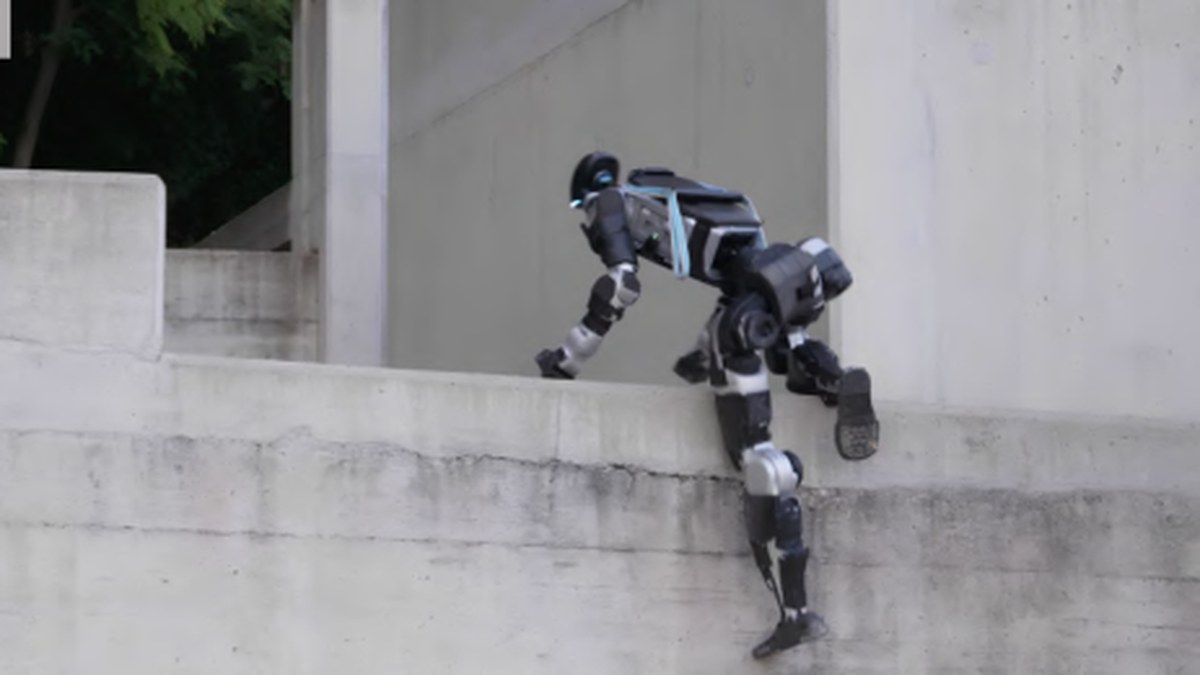
ETH Zurich built a controller that lets a Unitree G1 climb ladders, vault walls and recover from falls — by planning where to touch, not how to move.
Researchers at ETH Zurich have taught a humanoid robot to climb stairs and ladders, vault over walls, crawl through tight spaces and pick itself up after falling — all with a single controller, instead of a separate program for each skill. The system was demonstrated on a Unitree G1 and described in a paper posted to arXiv in October.
The core idea is contact, not choreography. Rather than scripting every joint movement in advance, the system plans where the robot should touch the world next. An attention-based planner reads terrain from the robot's onboard LiDAR — detailed enough to pick out features as small as ladder rungs — and chooses contact points for nine parts of the body: hands, elbows, knees, feet and pelvis. A second controller then turns those planned contacts into coordinated motion across the G1's 23 actuated joints. Both parts run at 50 times a second, adjusting continuously as the robot moves.
Training happens in three stages. First the controller learns coordinated movement from human motion data reshaped to fit the robot's body. Then the attention network learns to predict useful contact points from terrain scans, the robot's own state and its destination. Finally, reinforcement learning sharpens the whole system on terrain it has never seen. Once deployed, the robot needs no reference motion at all — only its sensors, its state and a goal.
In simulation the system completed 92.5 percent of runs across eight obstacle courses, against 58.8 percent for a competing motion-generation method. In the real world the G1 recovered from failed jumps, from attempts to stand that went wrong, and from getting stuck halfway up a ladder. The researchers stress that these behaviors come from one general-purpose controller, not a library of individually programmed skills.
The work is still focused on local navigation — getting across difficult ground right in front of the robot — rather than long-range planning or manipulation. But it addresses the gap between stage demonstrations and real deployment: most humanoid locomotion today is either choreographed or split into specialist controllers that break when the terrain changes. Treating contact as the interface between perception and control lets the robot improvise its way across ground nobody programmed for it — the kind of cluttered, uneven terrain found on construction sites, in disaster zones and in ordinary homes.
The paper, “Humanoid Mobility via Attention-based Contacts,” comes from ETH Zurich's Robotic Systems Lab, led by Junzhe He, with Vladlen Koltun and Marco Hutter among the co-authors. It was posted to arXiv on October 22. The team demonstrated the method on Unitree's G1, but the approach is framed around contact planning rather than any one robot's mechanics.