Unitree G1 overheats on Mount Tai and leaves on a stretcher
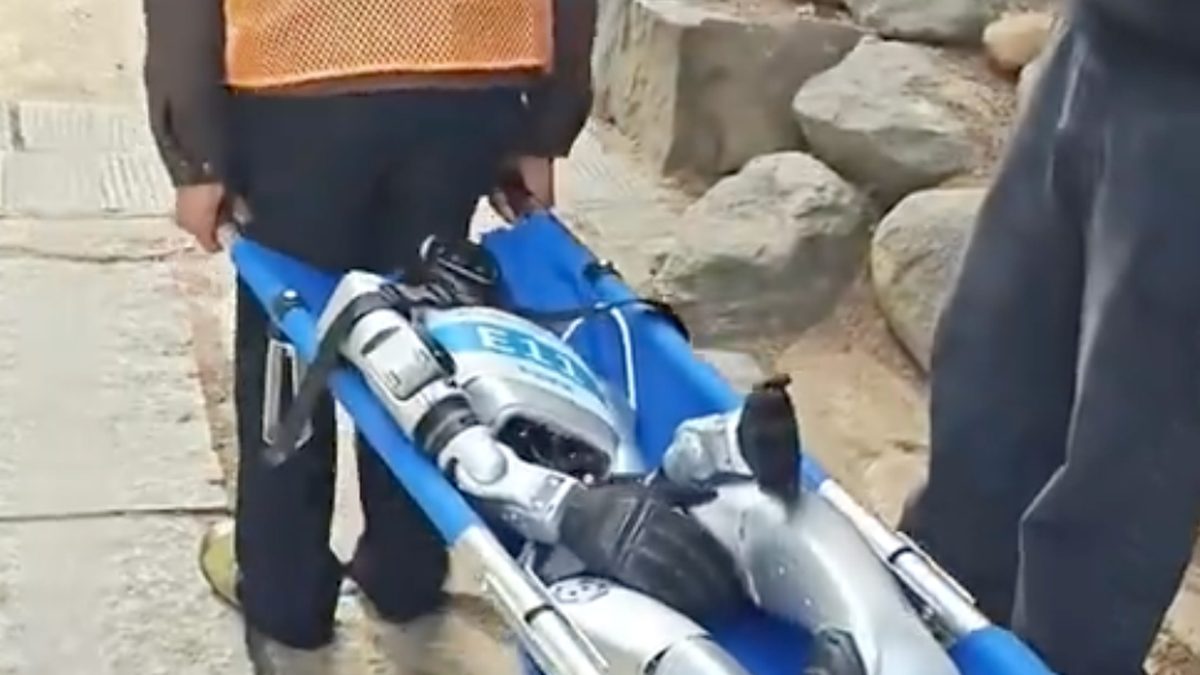
Unitree's G1 overheated mid-climb at the first CMG World Robot Mount Tai Competition and was carried down on a stretcher.
Unitree's G1 could not finish the climb up Mount Tai. The humanoid — the development version that performed at the CCTV Spring Festival Gala, entered by team Yongda Zhicheng — overheated midway through the first CMG World Robot Mount Tai Competition on Monday, and its operator withdrew it for safety. Staff put the robot on a stretcher and carried it down the mountain.
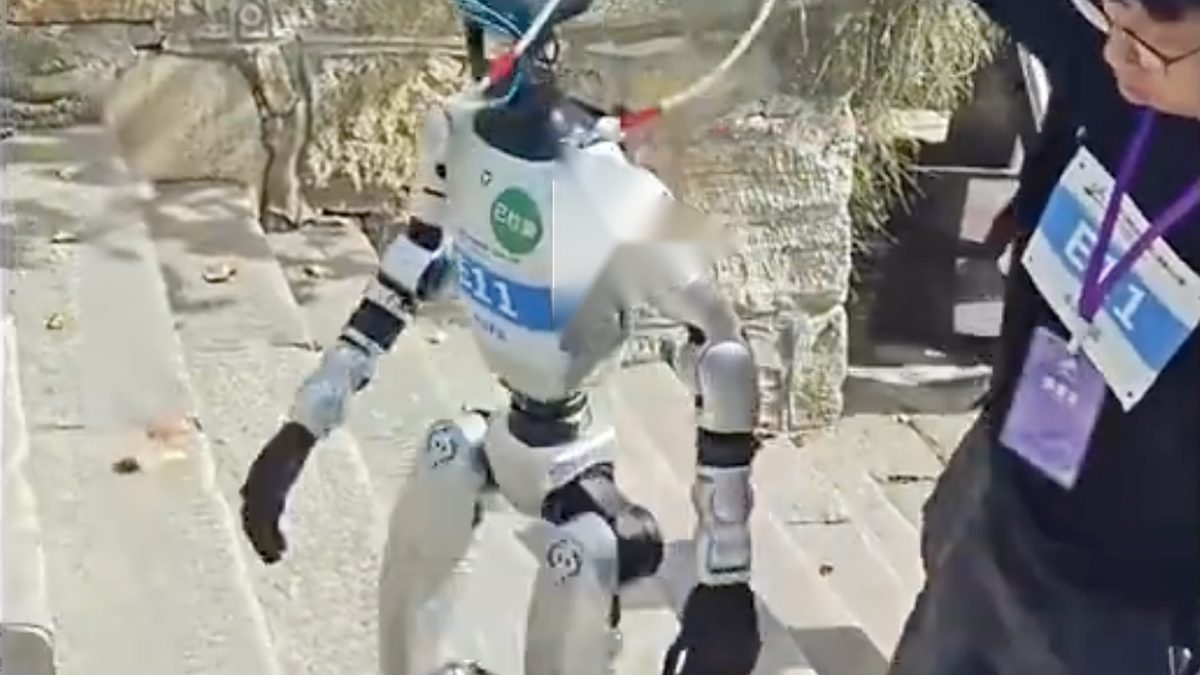
According to Jiemian News, the operator said the G1 developed a fault from overheating mid-race and, for safety, the team chose to withdraw. Onlookers watched it squat by the roadside, head bowed, before it was stretchered away — a moment netizens quickly turned into a meme. Global Times summed it up on X: “Too hot to finish the race… so I squatted by the roadside and emo'd.”
The course is a 3.9-kilometre climb of more than 3,100 stone steps with about 600 metres of ascent, run by around 90 teams across four official categories — humanoid speed, quadruped speed, quadruped load-carrying and exoskeleton assist — plus an all-terrain challenge. Robots set off at intervals of just over a minute.
The fastest humanoid belonged to Beijing team Zhishen Lingyue, which won the official humanoid segment — Hongmen Square to Doumu Palace, about 1.6 kilometres and 600 steps — in 27 minutes 26 seconds, then took the harder challenge segment to Hutiange in 55 minutes 34 seconds. In the quadruped speed race, a four-legged robot from Beijing Lingyi Technology, a Unitree subsidiary, finished in 43 minutes 41 seconds — a route state television noted takes most human tourists at least two hours. The load-carrying title went to Lingsi Intelligence's Ling Shi team, which carried two watermelons and two trays of eggs to the top in 1 hour 51 minutes 29 seconds.
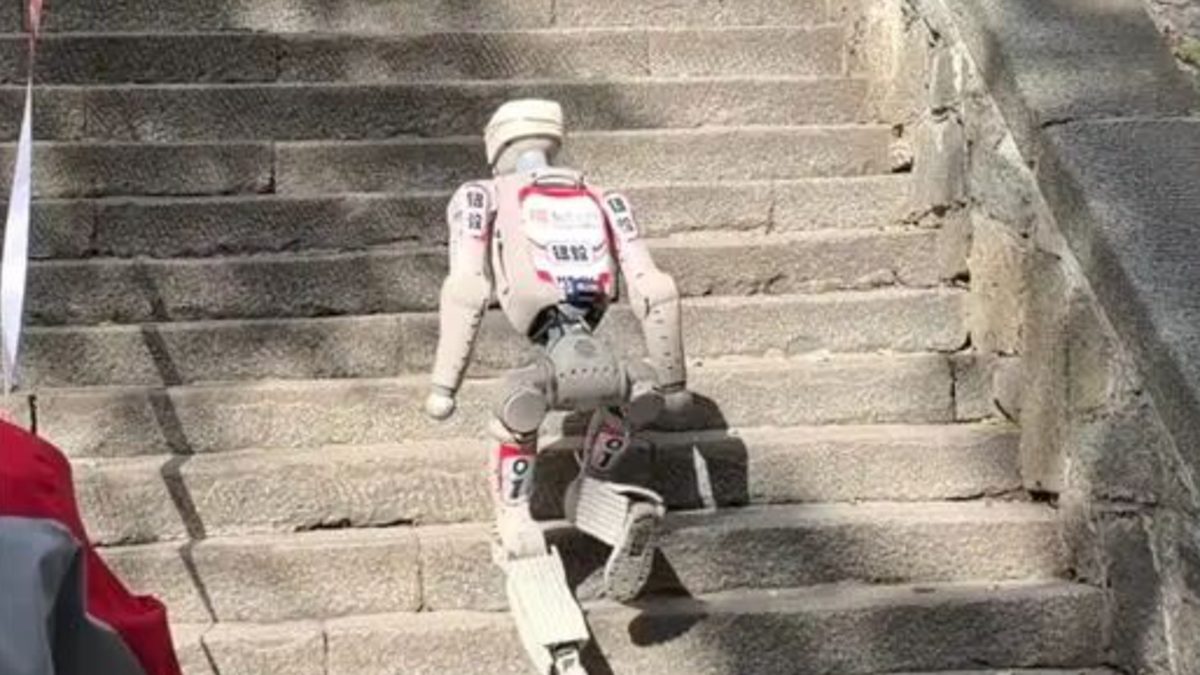
Not every machine made it look easy. One humanoid wearing a bandana collapsed in a heap on the cobbled route before engineers rushed in; another tumbled down a flight of stairs and came to rest beside a rubbish bin; the first humanoid finisher wobbled through the final stretch, in one report taking one step forward and three back, and some robots were led by a rope around the neck. Chief referee Su Qingwei said the qualifier had already exposed a stranger problem: the robots moved too fast for human referees to shadow them on foot. “Robots run on electricity, while we run on food,” he said. Mount Tai's uneven steps, cobbles, slopes and sharp turns are exactly the point — the organisers call the mountain a natural extreme testing ground. The G1's failure was a heat problem, not a walking problem, and on a 3,100-step climb in the open, heat is part of the test.