ACE Robotics' ACE-Brain-0.6 claims to top OpenAI's GPT-6 Astra on spatial grounding
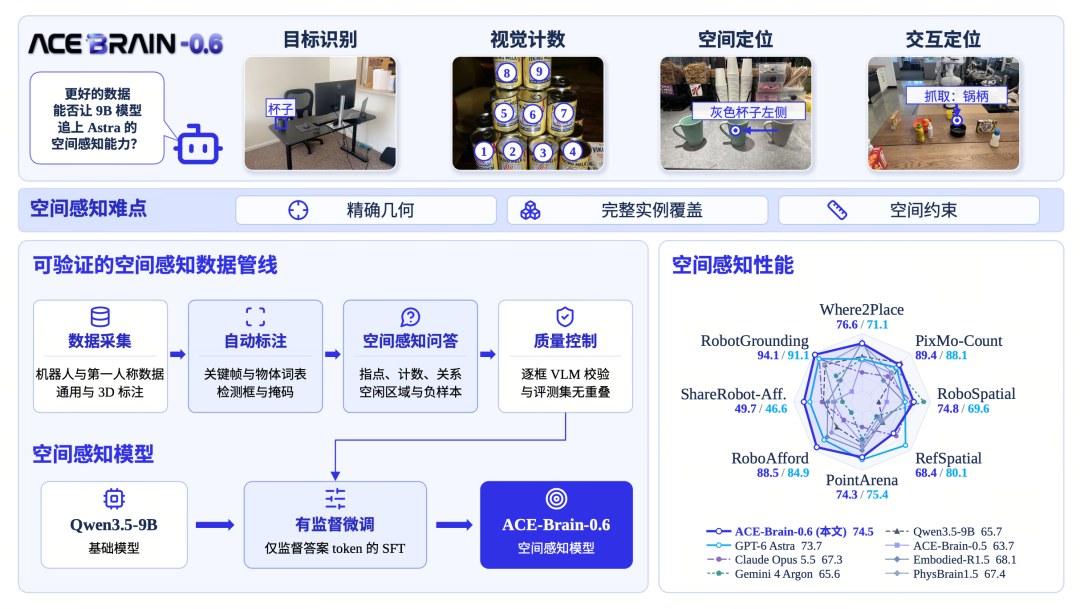
The 9-billion-parameter embodied model attacks the hardest gap in robot intelligence: turning what the camera sees into where the hand goes.
ACE Robotics has released ACE-Brain-0.6, a 9-billion-parameter embodied foundation model tuned for visual-spatial grounding, the company announced on October 19. The model targets the stage of robot intelligence where plans most often break down: converting high-level task understanding into precise physical action. That means identifying the target object, locating exactly where to interact with it, and anchoring the interaction to position, displacement and motion parameters.
The company claims ACE-Brain-0.6 outperformed OpenAI's GPT-6 Astra on six of eight grounding benchmarks, averaging 74.53 points across seven public evaluations against 73.68 for GPT-6 Astra. Reported margins include Where2Place (76.55 vs 71.10), RoboSpatial (74.82 vs 69.55), RoboAfford (88.51 vs 84.94), PixMo-Count (89.41 vs 88.10) and ShareRobot (49.70 vs 46.60). On the company's own RobotGrounding test — 2,591 questions across 14 task types — it scored 94.13 versus 91.10. ACE says the model also led comparisons with Google's Gemini 4 Argon, Anthropic's Claude Opus 5.5, Alibaba's DAMO Academy and the Beijing Academy of Artificial Intelligence models. All benchmark figures are company-reported and have not been independently verified.
Under the hood, the model was trained on about one million samples covering roughly 940,000 images and 2.7 million question-answer pairs. The data pipeline combines more than 30 open-source robot data families with private egocentric data, using automated annotation tools including Grounding DINO and SAM 3. The base model is Qwen3.5-9B, with a frozen vision encoder and supervised fine-tuning applied to the language-model parameters.
The most interesting number may be the scaling curve. Expanding training data from 260,000 to one million samples lifted the seven-benchmark average from 69.3 to 74.5 — roughly 2.4 points per doubling, a near log-linear gain. But simply adding more samples of existing data types improved performance by less than one point; introducing new scenes, spatial relations and supervision formats drove the larger gains. For teams building robot datasets, that is a practical hint: diversity beats volume.
ACE-Brain-0.6 continues a fast-moving lineage. ACE-Brain-0.5, detailed in a July 2026 paper, positioned itself as a unified embodied foundation model for what the authors called physical agentic AI, and ACE-Brain-0 followed a similar spatial-intelligence scaffold in March. The throughline is a bet that spatial cognition — the visual 'where' — is the shared foundation that lets one model serve robots, vehicles and drones alike, and that grounding, not planning, is now the binding constraint on manipulation.