X Square Robot Unveils WALL-OSS-1.0, a VLA Model Trained to Act Without Fine-Tuning
The Shenzhen startup says its natively pretrained vision-language-action model scored 55.1% zero-shot across 312 real-robot tasks.
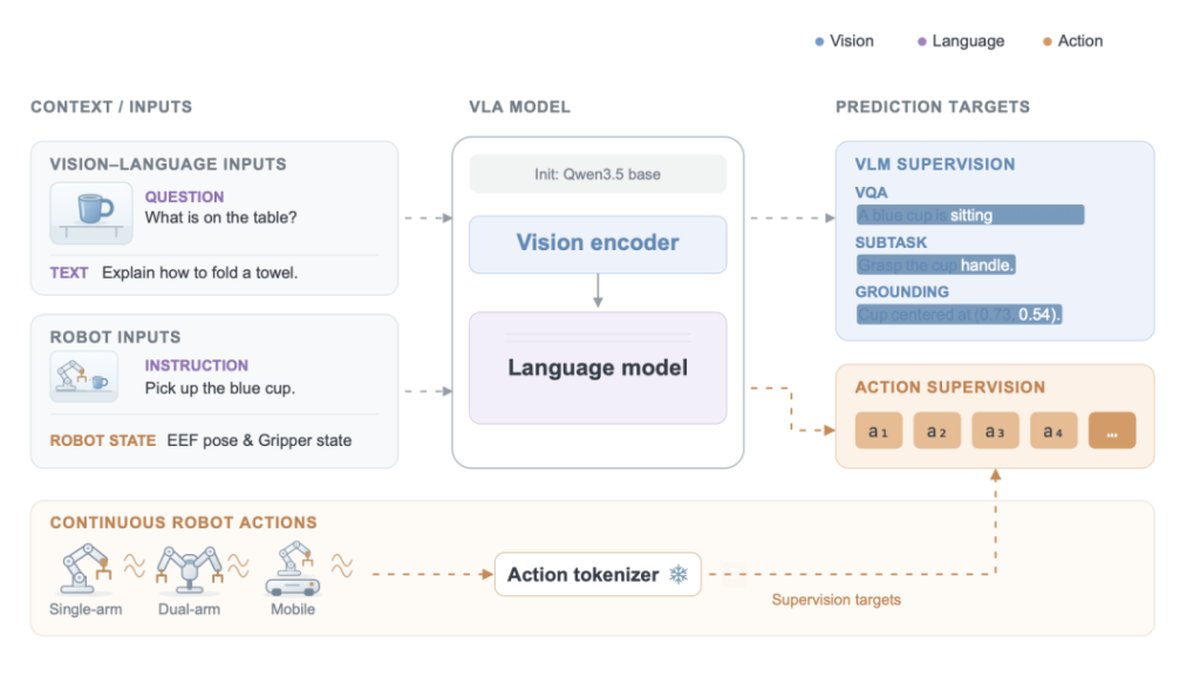
X Square Robot has released WALL-OSS-1.0, the latest version of its vision-language-action foundation model, built around what the company calls native VLA pretraining: vision, language and robot action learned together from the start of training rather than bolted onto a pretrained vision-language model afterward. In an open-ended real-robot evaluation, the company says, a single pretrained policy completed 55.1% of 312 unique tasks freely chosen by evaluators, with no task-specific demonstrations or fine-tuning.
The model starts from a Qwen3.5 base and folds language, vision-language and robot-action data into one autoregressive training process. An improved action tokenizer turns continuous robot movements into compact discrete tokens, so physical experience is learned in the same sequence space as words and images. Training objectives go beyond imitating demonstrations: the model also learns to describe actions, judge proposed behaviors and correct errors, while a flow-matching action expert converts context into smooth, continuous robot commands.
On the company's own benchmarks, WALL-OSS-1.0 posted an overall score of 67.55 out of 100 on X2Real, its simulation suite of more than 40 reasoning and manipulation tasks, against 40.94 for Lingbot-VLA-2.0, the strongest other open-source baseline it tested. In out-of-distribution mobile manipulation it scored 44.17 against 24.83 for pi0.5. The compact WALL-OSS-1.0-Lite ranked first among policies without agent systems on the public RoboDojo simulation leaderboard as of November 5, with 42.59 points. On ManipArena, a 15-task real-world tabletop benchmark, the model scored 1,101 of 1,500 points straight after pretraining, a 50.67% success rate against 19.33% for its predecessor WALL-OSS-0.5 and 24.0% for a multi-task fine-tuned pi0.5.
Alongside the model, X Square introduced XR Harness, an agentic framework that splits work between a planning layer that interprets goals and revises steps, an execution layer where WALL-OSS-1.0 generates actions while monitors check completion, and a control layer that talks to robot hardware. Robot trajectories are annotated at four levels of language, from broad task down to individual movement segments, so the planning layer can steer manipulation in plain words. A developer preview of XR Harness is available now.
The company is also putting the model to work in parcel sorting for a logistics customer, where robots orient barcodes, align parcel edges and feed packages into sorting lines. X Square says a sorting policy built on WALL-OSS-1.0 kept more than 90% of its original speed and success rate when moved to a different site with different lighting, tables and parcel mix, while a policy trained without the pretrained foundation lost more than 90% of its success rate across sites.
WALL-OSS-1.0 arrives as a family: Lite at 4 billion parameters and Nano at 2 billion for cheaper adaptation and inference, a Gen variant that learns from broader visual experience including first-person human video, and an AR variant exploring autoregressive action generation. The company says Nano served 18 robots from a single NVIDIA Blackwell GPU in its tested configuration. A new WALL-API-1.0 opens the model to developers and enterprises, and X Square says code and model weights will be open-sourced soon, continuing the open WALL-OSS line that began with its earlier releases.