Swiss Startup coprod Raises $6M to Make Robot Hardware as Easy to Build as Software
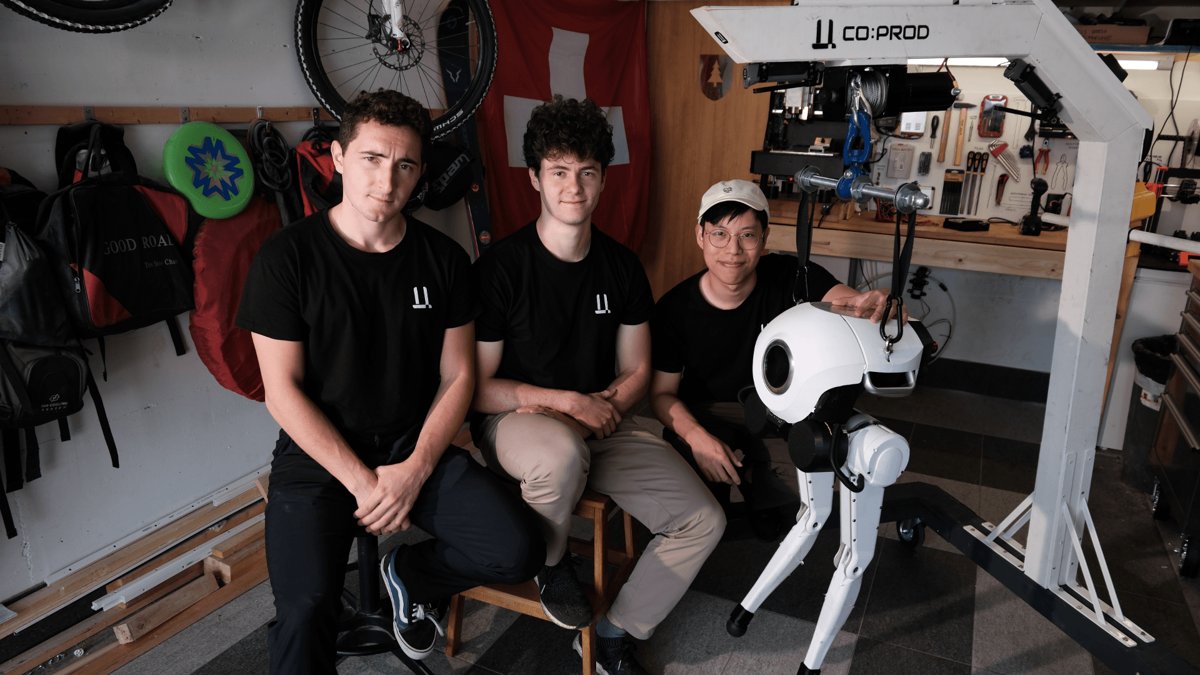
Founderful and PROTOTYPE led the pre-seed round; the Lausanne company sells compatible modules on one EtherCAT control plane.
Swiss robotics hardware startup coprod has raised $6 million in pre-seed funding to bring its modular hardware stack to market and open a prototyping facility in Lausanne. Founderful and PROTOTYPE led the round, with participation from General Catalyst, Pace Ventures, Tiny Supercomputer Investment Company, Kima Ventures, SDAC, Unruly Capital and Venturekick. Angel investors in the round include Hugging Face founder Thomas Wolf, the Dassault family and Florent Perrichon.
coprod builds compatible hardware components it calls co:products, covering power, battery, sensing and motion, unified through a software stack named co:system. The modules run on a single real-time EtherCAT control plane with one developer API in C++ and Python, and each module can work as part of a complete system or be integrated on its own. Published specifications list a 100 Mb/s bus, a typical 1 kHz control loop and timing jitter below 20 microseconds.
The company targets what its backers call integration hell: building a robot around custom, task-specific hardware has traditionally taken large expert teams two to three years. coprod says its stack lets a small team do the same work in a few months at $5,000 to $25,000 per design iteration. Chief executive and co-founder Loic Delineau argues that a robot with purpose-built hardware for a specific task will do that task faster, cheaper and more reliably than a general-purpose machine, and that the company's job is to abstract away the complexity of building such robots.
Delineau, Vincent Nguyen and Matthias Schuller, graduates of EPFL, formed coprod in late 2024 and proved the approach by building a bipedal robot demonstrator in a garage in the Swiss Alps. Its components now power several robots in the Swiss ecosystem, including the first student-built Swiss humanoid from the ETH Robotics Club, which recently took its first steps in Zurich. coprod is lining up partnerships with robotics integrators and laboratories to validate prototypes ahead of a commercial launch early next year.
The new capital funds the first commercial component line and a full-stack prototyping facility in Lausanne equipped with CNC lathes, mills, lasers and electronic testing gear. The workshop is designed to cut development cycles from two weeks to 24 hours while producing datasheets and digital-twin models for each component. By the end of 2027, coprod plans to have its entire component line qualified, certified and on the market, with large-scale production in Shenzhen and Texas and its headquarters, core team and research operations remaining in Switzerland.
The bet lands on a real bottleneck. Humanoid makers still rely on specialized component supply chains with little standardization, and an April 2026 McKinsey analysis estimated actuators alone at 40% to 60% of a humanoid robot's component costs. coprod cites McKinsey estimates that actuators, sensors and control systems of the kind it builds could form a $28 billion market by 2030. Whether robot builders adopt shared modules before volumes and interface standards settle is the open question the round now funds coprod to answer.