That Viral Robot 'Meltdown' Over a Plush Duck Is Just a Parcel Sorter Doing Its Job
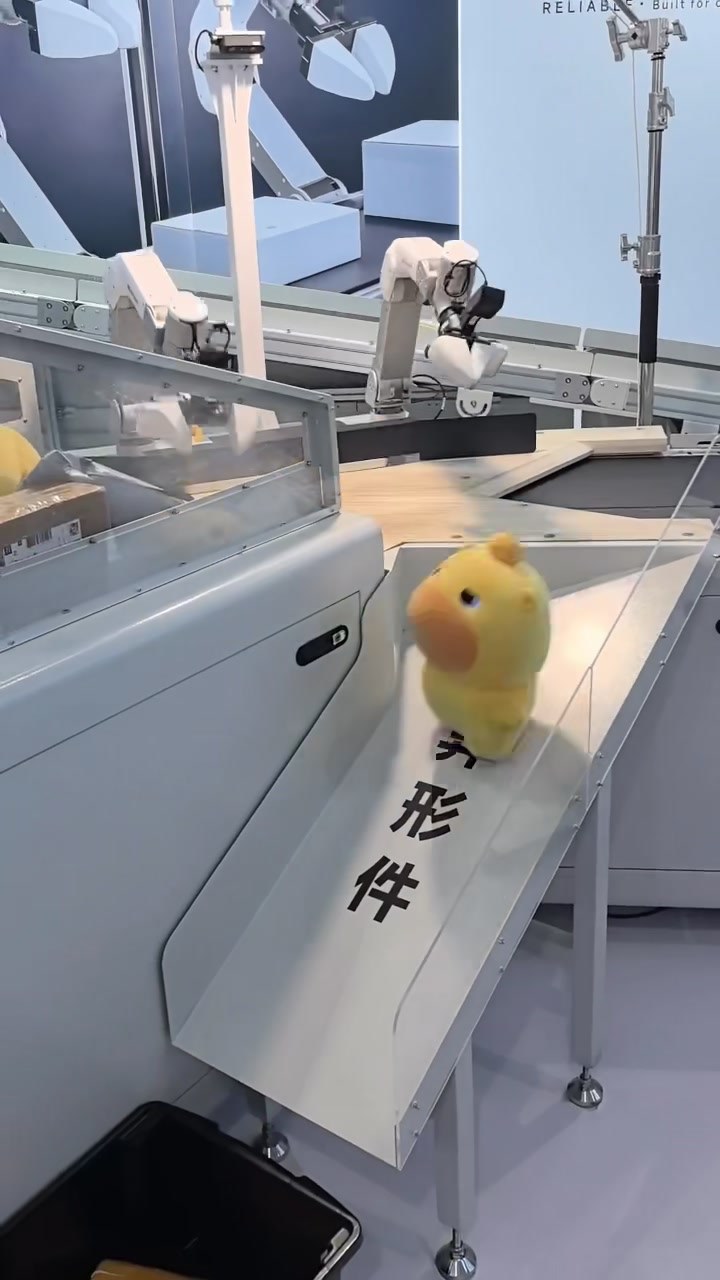
X Square Robot's WALL-B sorts parcels in China, odd-shaped ones included. The clip going around X is real, but the numbers are from August.
A dual-arm robot picks up a yellow plush duck, carries it across a sorting station, and drops it down a chute. On X, where the clip is going around this weekend, people are joking that the robot is having an emotional breakdown. The footage is real. The breakdown is not.
The robot is part of a parcel-sorting system powered by WALL-B, the embodied AI foundation model from Shenzhen-based X Square Robot. The chute the duck slides down is marked for odd-shaped items. A soft toy with no flat side and no barcode is exactly the kind of thing the chute is for. The robot did its job.
The numbers behind the clip come from August. On August 12, X Square Robot livestreamed WALL-B sorting parcels from a disorganized pile, reporting 1,816 parcels an hour at more than 98 percent accuracy. Later that month, at the World Robot Conference in Beijing, the company ran a five-hour challenge: 10,000 parcels in 5 hours, 14 minutes and 1 second, or about 1,911 an hour -- roughly 1.88 seconds per parcel. Those figures are the company's own, from controlled demonstrations.
Parcel induction is a harder job than it looks. Every grasp changes the shape of the pile. Boxes and soft packages stack and overlap, labels face the wrong way, and the best surface to grab is often buried. The system has to pick items one by one, turn labels toward the scanner, smooth out soft packaging, right tilted boxes, and recover when a grasp fails. Wang Qian, X Square Robot's founder and chief executive, has said the challenge is not completing a single clean grasp, but continuing to make correct decisions as the pile changes shape.
X Square Robot compares its rate with Figure AI's Figure 03 humanoid, which it puts at 1,248 parcels an hour. That comparison comes from the company itself, and the two systems were tested under different conditions -- a fixed arm over a pile versus a walking humanoid working a long shift -- so it is a marketing benchmark, not an independent one.
The company calls its approach 'one model, many applications,' and the same WALL-B model showed up at the Beijing conference in several other bodies: two wheeled humanoid robots taking spoken commands to organize household items, retrieve objects, clean, water plants and handle pet chores; a 22-degree-of-freedom, five-fingered dexterous hand that unboxed a fan, switched it on and checked that it was running; and a dual-arm system that arranged flowers from visitors' spoken requests, replanning when the vase was moved.
X Square Robot says the WALL-B system already runs on a live parcel-sorting line and is built for continuous, round-the-clock operation. The company has also moved into homes: it partnered with local-services platform 58.com in March on a home-cleaning service, and in May it began placing robots with households for extended in-home service.
The clip is fun because the duck looks like a tantrum. The serious point is the one the post makes: for physical AI, the question is not whether a robot can do a task once on camera. It is whether one model can keep working reliably across different objects, orientations and environments. A five-hour run at about 1,900 parcels an hour is a better test of that than a 30-second clip -- and the clip is still worth watching, because it shows the messy part of the job: the odd-shaped stuff.