Apple's HALO Trains a Humanoid in 1,000 Fake Homes — Then It Works in Real Ones
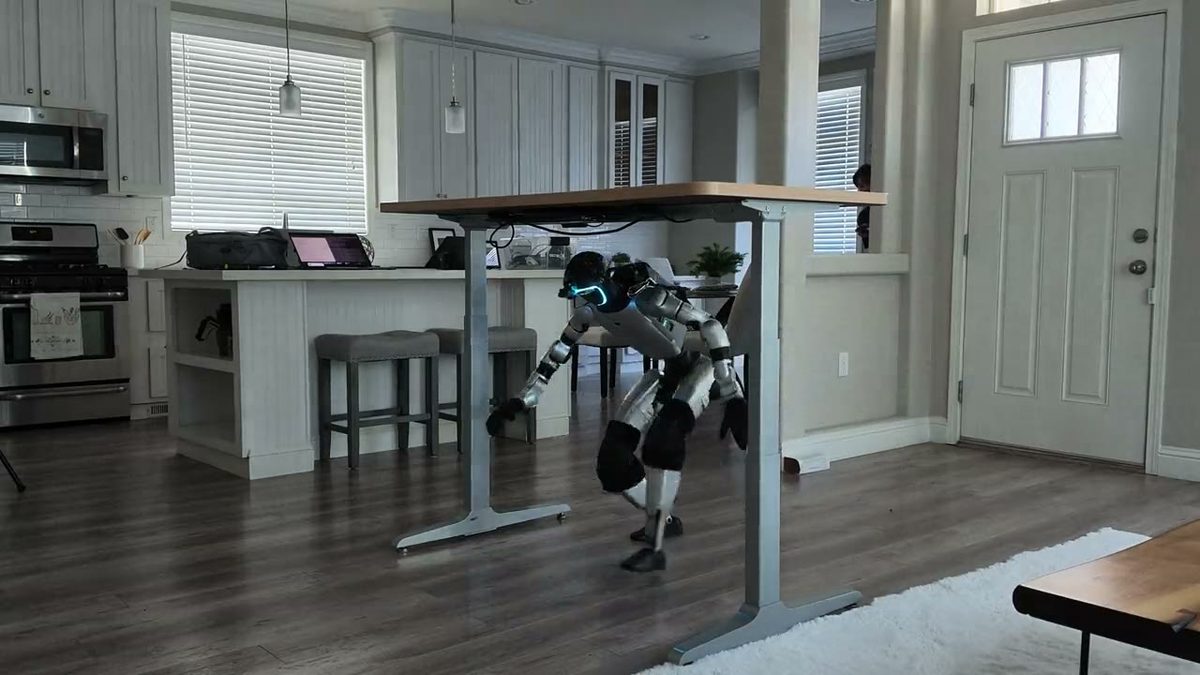
Trained only in simulated homes, Apple's HALO completed 91% of 360 real-world trials on a Unitree G1 — no teleoperation data, no maps of the rooms.
Apple researchers have taught a humanoid robot to work in homes it has never seen — by training it only in homes that do not exist. The system, called HALO, completed 91 percent of 360 trials in six real homes it had never been shown, scanned or mapped, running on a Unitree G1. The work is described in a paper posted to arXiv on November 4, “Perceptive Humanoid Motion from Simulation.”
The target is the data bottleneck holding humanoid control back. Robots need large datasets linking camera images and language to joint commands, and collecting them by remote control is slow: the paper puts the cost of teleoperation and wearable capture at at least an hour of human time for every hour of data. HALO builds its data instead, generating about 300 hours of episodes across 1,000 procedurally built homes, so the dataset grows with computing power rather than human labor. Generating the main training data took 48 hours on 250 Nvidia H100 GPUs, with no human intervention.
The robot learned six skills: walking to a named object or person, sitting on a chair or sofa, sidestepping through a half-open door, crouching and crawling under tables, pushing a box, and following a person. It can also chain them into longer jobs. In the real-world tests, each skill ran 10 times in each of the six homes. Crouching scored 100 percent, sidestepping a door 93 percent, walking to a target 92 percent, crawling 90 percent, pushing a box 88 percent and sitting 85 percent — a 91 percent average. Longer jobs were harder: across three multi-step sequences in one real home, the average fell to 70 percent, and a three-step job of crouching, walking to a target and pushing a box worked only half the time.
The hardware is deliberately ordinary. HALO runs on a Unitree G1 with 29 joints, fitted with a head-mounted camera and a rear enclosure holding a Mac mini with an M4 Pro chip and 64GB of memory. The Mac mini runs the two heavy AI models, while the robot's built-in Nvidia Jetson Orin NX runs the fast motion tracker and a depth model fed by a downward-facing RealSense camera. Control splits into three layers: a vision-language model orchestrator that breaks a spoken request into subtasks about every two seconds, a motion generator that turns the camera image and the current subtask into a five-second whole-body plan, and a tracker running 50 times a second that sets targets for all 29 joints. The default planning model runs locally on the Mac mini, so the robot works without an internet connection.
The team has published the full pipeline as open-source code, covering data generation, model training and deployment in simulation and on a real G1. The paper is candid about the limits: the robot relies mainly on vision, so it cannot directly sense contact, and contact-heavy tasks get worse when an object leaves the camera's view. New tasks still need human-written prompts and designed motion keyframes. The paper also runs no head-to-head tests against rival systems. And Apple has said nothing about a product — this is research, not a robot for sale. But it is a concrete answer to the question every humanoid maker faces: how to get enough training data without an army of human operators.