Unitree's UniUni lets one operator choreograph a whole robot dance troupe with text
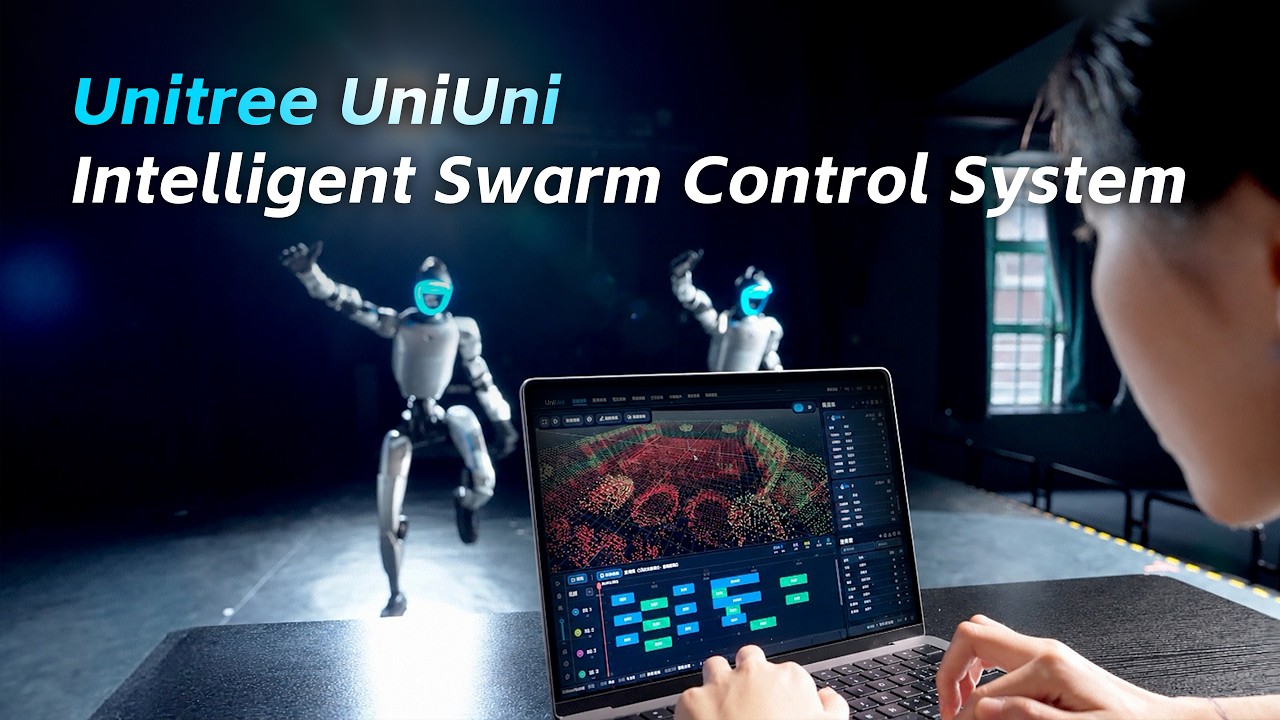
The swarm control system pairs LiDAR stage mapping with a timeline editor and natural-language choreography changes.
Unitree Robotics has introduced UniUni, an intelligent swarm control system for coordinating groups of robots during performances, the company announced on October 19. The system lets a single operator manage robot teams and rewrite choreography through natural-language instructions, rather than programming each machine separately — a notable step toward making multi-robot control usable by choreographers instead of engineers.
The interface combines three tools in one screen. A stage-mapping view renders a LiDAR-generated point cloud of the performance area; Unitree advertises centimeter-level scene reconstruction for planning where each robot goes. A choreography editor gives every robot its own timeline track, with a library of predefined dance moves that can be arranged into routines. And a natural-language prompt window — what Unitree calls “AI choreography” — lets the operator type requests to change movements, add paths or rearrange formations, with a robot-position grid linking the words to the stage layout.
UniUni also folds the operational layer into the show console: per-robot battery and temperature monitoring, plus emergency stop buttons for every machine. In Unitree's demonstration, a low-battery warning prompts the crew to swap out a performer mid-routine — maintenance handled inside the performance workflow rather than as a separate fire drill.
What Unitree did not say matters as much as what it did. The company has not identified the AI model behind the natural-language choreography, explained how text instructions become executable motion, or disclosed pricing, availability, supported robot models or maximum fleet size. And as Interesting Engineering notes, the system is a centralized choreography tool for staged performances: there is no evidence yet of decentralized coordination, and no stated industrial application — the company's figures on setup time, reliability or coordination accuracy remain company-reported demo claims.
Still, UniUni points at where Unitree's business is heading. The company already sells some of the world's most widely used humanoid and quadruped robots; now it is selling the software layer that makes fleets of them manageable. If multi-robot deployments are the next scaling story in embodied AI, the company that owns both the hardware and the control plane starts with a head start.