How Tutor Intelligence turns human mentors into robot training data
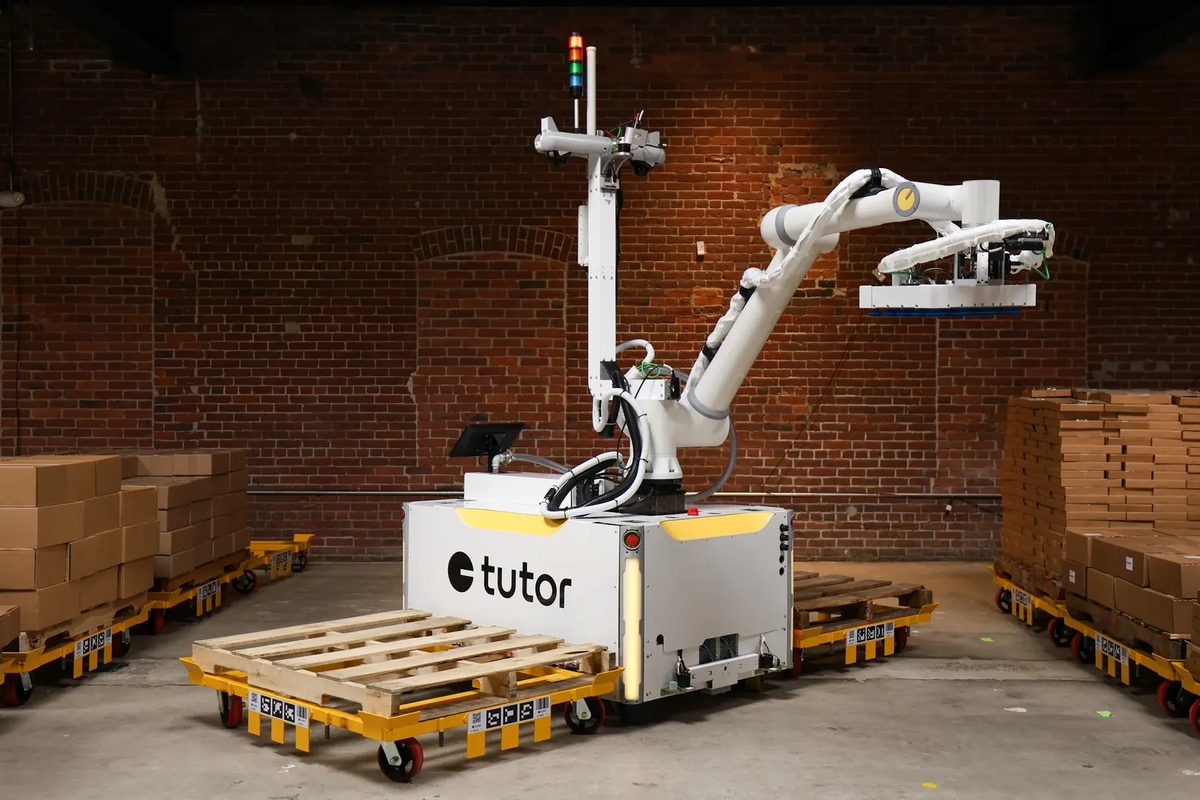
Tutor rents out robot workers by the hour, with remote humans guiding them — and every shift becomes training data for the next robot.
Tutor Intelligence, a Watertown, Massachusetts robotics company spun out of MIT CSAIL in 2021, has a different answer to the hardest problem in warehouse automation: do not wait for the robot to be fully autonomous. Put it to work now, with a remote human guiding it, and let every shift teach the whole fleet. The approach just won the company a $75 million Series B led by Andreessen Horowitz, announced November 2, bringing its total raised to $117 million.
The founders are Josh Gruenstein, chief executive, and Alon Kosowsky-Sachs, chief technology officer, who met as undergraduates at MIT and incorporated Tutor in February 2021. Gruenstein's starting question was a practical one: robotic arms, cameras and computing are mature, so why is so much physical work in factories and warehouses still done by hand? Tutor's answer is that robots lack real-world experience. Large language models learned from the internet's text; robots have no equivalent database of physical work. Knowing what a cardboard box is does not mean knowing how to pick up a dented one, or how to recover when a grasp fails.
So Tutor put human guidance at the center of the system instead of treating it as a stopgap. Its fleets of internet-connected robots work in customer facilities, doing real jobs with input from remote operators the company calls "tutors." Every operation becomes training data for its robot foundation models, which in turn make the fleet more capable. Andreessen Horowitz, which led the round, puts it this way: every robot put to work makes the next one "smarter, cheaper, and easier to deploy." It is the reverse of the usual robotics order — deploy first, and let autonomy catch up on the job.
The workhorse is Cassie, a single-arm mobile manipulator built for the unglamorous middle of the supply chain: de-palletizing, induction, end-of-line palletizing and repackaging. The robot carries a 50-pound payload, picks at up to 14 cases a minute, and runs a 16-hour battery in a machine weighing about 2,000 pounds. It runs on Tutor's Turing series of robot foundation models — the 200-million-parameter family — using its cameras to perceive the environment and take on new tasks without programming, operator configuration or vendor customization, according to the company.
In September, Tutor unveiled the next generation of Cassie alongside a second robot, Sonny. The new Cassie is fully autonomously mobile on four wheels, driving between workstations instead of waiting for work to come to it, and this fall it is deploying for the first time into full end-to-end case picking. Sonny has two arms and more dexterity, built for piece picking: its first job is e-commerce fulfillment, navigating existing warehouses, picking individual items out of racking and delivering completed orders to packout. Sonny is the first robot built for Tutor's newest model, Ti0, a 4.5-billion-parameter vision-language-action model. The company says it is working with partners to extend Sonny into assembly-line packaging, assembly and maintenance work in manufacturing — a stated expansion plan, not a deployment that exists yet.
The training data comes from two places. One is the customer site itself. The other is DF1, Tutor's Data Factory at its Watertown headquarters in a renovated mill — a room of 100 bimanual manipulators the company calls a "kindergarten" for its robots, where remote tutors train and evaluate the Ti0 model. Tutor claims it is the largest robotic data factory in the United States. The tutors — 45 to 50 of them, working remotely from Mexico and the Philippines using proprioceptive teleoperation, plus on-site staff — run the same policy across all 100 arms, which the company says lets it detect and correct robot behaviors 100 times faster than testing on one machine. The factory opened to visitors in April 2026. Its role is to run alongside commercial deployments, not instead of them: commercial work produces data at scale, and training turns that data into capability.
Tutor's growth figures, all reported by the company and not independently audited, describe a fleet scaling fast. Twice as many robots are now working in almost four times as many facilities as a year ago. The company says it is on track to have more than 1,000 robots under contract by the end of 2027 — a forward target, not an installed base. Cassie has completed millions of bulk picks in production, and the median time from signed paperwork to robots in production is about 40 days, with picking starting on the first day of most deployments. Nearly a third of the organizations that received Tutor robots in the past 12 months were existing customers installing more. The company said in September that its fleet was growing 20 percent month over month, and it now employs more than 160 people, up from about 60 at the end of 2025.
The business model is the part Tutor is most careful to define. It does not call itself robotics-as-a-service. On its pricing page, the company says RaaS "often has hidden catches," and that it offers usage-based pricing instead: customers pay only for what they run, by the hour or by the pick, with no long-term contract. Palletizing and depalletizing run $14 to $18 per robot-hour, with a minimum of 80 hours a month, all-in — support, maintenance and every model improvement included. Case picking is priced per pick, at 10 to 50 percent below what a pick costs the customer today; the site gives an estimated $0.21 to $0.38 per pick and labels those figures estimates, not committed pricing. There is a flat $10,000 implementation fee, a refundable $8,000 deposit, and freight of $1,000 to $3,500 from Watertown. A remote operations team watches every robot around the clock, and a robot that needs work is swapped out rather than repaired on the customer's line. Customers can also buy Cassie outright, subject to conditions and an annual service fee.
The pitch is aimed squarely at smaller operators. A family-owned manufacturer does not have to fund equipment, integration and maintenance up front, or reconfigure its line around a fixed automation cell. The risk moves to Tutor instead: idle robots, breakdowns, remote support and field service all eat into the company's margin, so the model only works if utilization stays high and the robots keep needing less human help. The honest comparison is not robot-hour versus worker-hour, but the cost of each qualified unit of output — how many picks an hour, how often a person has to step in, how much downtime costs.
The early evidence, all from the company or its customers, is specific. BetterBody Foods runs Tutor palletizing robots at facilities in Lindon, Utah and Greenfield, Massachusetts; its facility manager says the robots saved 36 percent compared with the cost of a worker on palletizing, and the company plans to add three more Cassies. Productiv, a third-party logistics provider doing kitting, contract packaging and custom fulfillment in Richmond, Virginia and Dallas, Texas, says its Tutor deployment was profitable from day one, with 99.9 percent quality, 350,000 kits shipped, and new-product programming time cut from five days to one. The robots handle breakfast cereals, snacks, candy, cosmetics, home goods and toys, for customers Tutor describes as ranging from family-owned manufacturers to Fortune 50 logistics providers.
Tutor's competition is best understood by the job, not the shape of the machine. In heavy logistics, Dexterity's Mech — a dual-arm mobile manipulator the company calls an "industrial superhumanoid" — loads and unloads trucks, with a flagship deployment at a FedEx hub in Hagerstown, Maryland. In parcel sorting, Ambi Robotics' AmbiSort has sorted more than 100 million packages at a claimed 99.6 percent accuracy, while its AmbiStack builds mixed-SKU pallets from a fixed gantry overhead — the opposite of Tutor's mobile approach. In piece picking, RightHand Robotics' RightPick is a fixed workcell: vision and machine-learning software plus smart grippers mounted on third-party arms, built for e-commerce fulfillment. And in the service model itself, Formic offers manufacturers robotics-as-a-service at $8 to $15 per robot-hour, with more than 400,000 production hours behind it — a lower hourly anchor than Tutor's $14 to $18, and a reminder that usage pricing is not Tutor's invention.
What will decide whether Tutor's version works is the part no announcement discloses: how many robots one remote tutor can support, how fast intervention rates fall as the models learn, and whether experience gained on one customer's boxes transfers to another's. Tutor's own framing is that deployment is the training strategy — the robots earn their keep while they learn. If the intervention cost falls as the fleet grows, each deployment makes the next one cheaper, and the 1,000-robot target for the end of 2027 is a milestone on the way to a labor platform. If it does not, the company is a technically enhanced labor service with expensive hardware. Revenue and valuation were not disclosed in the Series B announcement, so there is no public yardstick yet for which story is winning. The next year of deployments will provide one.