Aptiv to Deploy 100 TARSBOT Humanoids by Year-End as First Units Start Work on Its Factory Floor
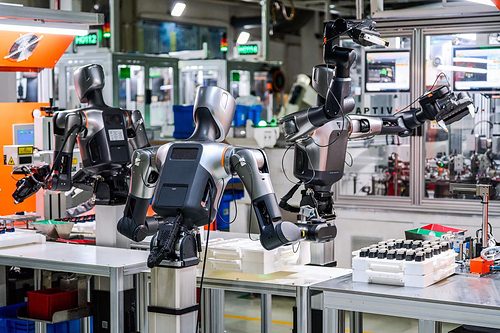
TARSBOT and Aptiv signed a deal at CIIE to put 100 A-Series robots on Aptiv factory floors by year-end, with a 1,000-unit fleet in the works.
Aptiv plans to have 100 TARSBOT A-Series industrial humanoid robots working across its factories by the end of this year, the two companies said at the 9th China International Import Expo in Shanghai, where they signed an agreement to deepen their collaboration on embodied AI. The first batch of robots is already operating on a real production line at an Aptiv smart factory.
The deployment will cover eight manufacturing process categories and 33 application scenarios, including flexible assembly, coordinated inspection and production management. Aptiv will fold its high-performance computing platforms and intelligent power distribution systems into the robots, giving them the onboard compute and electrical backbone for perception, decision-making and motion control in a live industrial setting. The two sides plan to reach mass production in 2026.
The agreement is the next step in a partnership that has been building for months. With support from the Jiading District Government of Shanghai, TARSBOT and Aptiv are working toward what they describe as China's first industrial embodied AI robot fleet, at a target scale of 1,000 units. The first phase is being implemented at an Aptiv production site, where the focus is adapting the robots to real production processes and manufacturing requirements. The signing at CIIE moves the cooperation into a more systematic and scaled phase, the companies said.
Data from the factory floor will feed back into AWE, the AI World Engine, TARSBOT's general-purpose foundation model for embodied AI. The idea is a loop: robots work real production jobs, the production data improves the model, and the improved model makes the next deployment smoother. Both companies say the goal is a validated, replicable reference for scaling embodied AI across more factory scenarios.
TARSBOT, formally TARS Robotics, was founded in February 2025 and is based in Shanghai and Beijing. Its A Series is an industrial humanoid with a wheeled or fixed lower body, while its T Series is a general-purpose biped. Both share a single AI brain and dexterous five-finger hands. The company says its robots can perform wire-harness assembly and two-handed hand embroidery with sub-millimeter precision — claims the company has put forward but that have not been independently verified on a production line.
For Aptiv, a global automotive technology supplier, the deal is a test of whether embodied AI can hold up to the engineering standards of a tier-one manufacturer. Combining TARSBOT's end-to-end embodied AI capabilities with Aptiv's engineering expertise and rigorous standards is meant to support efficient, reliable deployment at scale, the companies said. As manufacturers worldwide face growing demand for intelligent automation, the partnership is one of the first large-scale attempts to prove that humanoid robots can earn their keep on a real factory floor — not in a demo hall, but on a production line that has to ship product.