Swiss Robotics Day Shifts the Humanoid Race From Legs to Hands
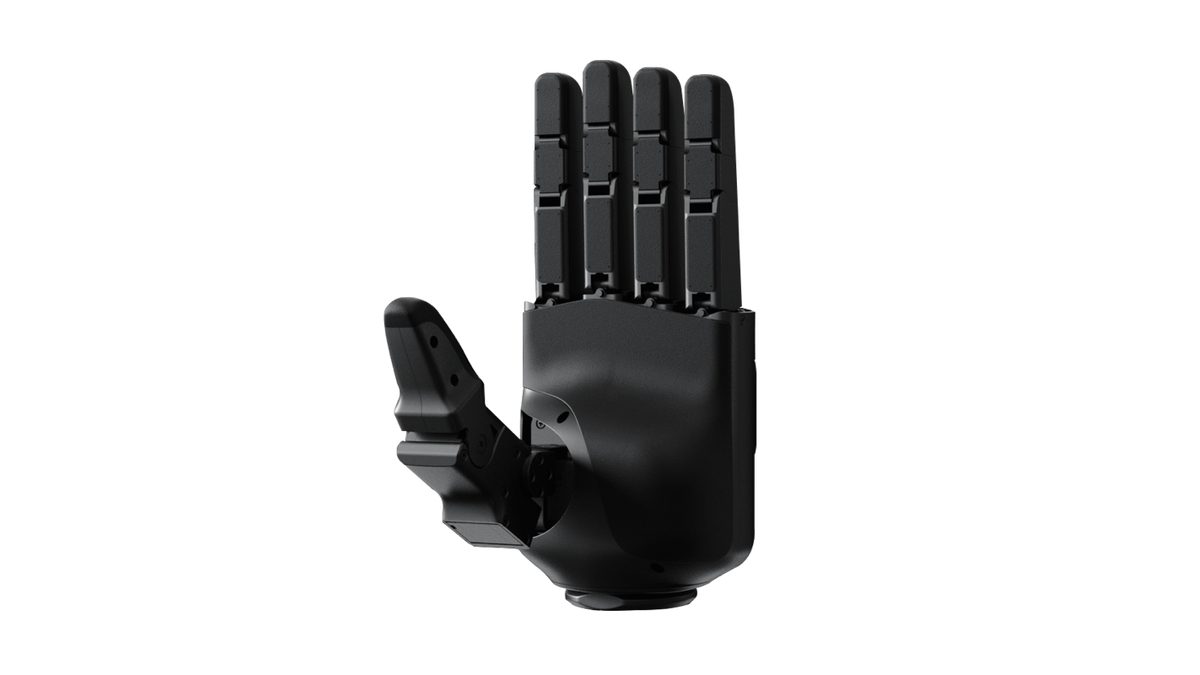
Unitree showed a human-sized hand with more than 20 degrees of freedom and Inveel unveiled skin that feels forces as small as 0.0005 N.
Swiss Robotics Day 2026 opened with a small drama on the main stage in Zurich. An object held by a robotic hand began to slip. Just before it fell, the hand curled its fingers and caught it, reading the change in tactile information at its fingertips and adjusting its grip. The moment set the theme for the day: after years of rapid progress in walking and balance, the humanoid field's next hurdle is the hand.
About 170 machines gathered at the StageOne Event and Convention Center on November 13, and the floor was thick with demonstrations of grasping, moving, and force control. Unitree founder Wang Xingxing presented a dexterous hand roughly the size of a human hand, with more than 20 degrees of freedom, and said the drive structure between the fingers and the hand is built to absorb large impacts. The hand was the centerpiece of Unitree's appearance at the event, where the company also showed its quadruped and humanoid lineup.
The most precise sensing on show came from Swiss startup Inveel, which unveiled a robot skin 500 micrometers thick. A single thin sensor detects pressure and contact, and senses an object approaching before it touches. It recognizes objects up to 15 centimeters away and distinguishes forces as small as 0.0005 newtons. Aude Billard, head of the robotics center at EPFL, the Swiss Federal Institute of Technology in Lausanne, called dexterous manipulation one of the hurdles keeping robots from real-world deployment. Her team has spent five years studying where people place their hands and how much pressure they apply while learning precision tasks such as watchmaking. Understanding how people acquire fine hand skills, she said, matters more than collecting large amounts of motion data.
The factory floor is where the gap between a demo and a deployment shows. Enno de Lange, director of physical AI and robotics at Hexagon Robotics, put photos of a banana, a kitchen, and an alpine trail on screen and told the audience his robots never see any of that. Hexagon's humanoid AEON works on BMW production lines, handling small, featureless industrial parts, some of them shiny metal, in processes that are often confidential, so there is no public training data at all. On one BMW task, AEON removes battery cells from a tray and loads them into assembly equipment, with about 30 seconds per cycle, repeating the same motion at a fixed pace all day without dropping parts. "Demos are easy," de Lange said. "You can prepare for a long time, and if you fail, you try again. Many people underestimate the gap between showing something once or a few times and showing it reliably hundreds of thousands of times."
Teaching the hand is the other front. Lori Sexton, a director at Agile Robots, estimated that a person accumulates about 24,000 hours of experience perceiving space and controlling their body over a lifetime, which is why someone can walk into a home they have never visited, open a door, find a cup, and make tea. "This is not a hardware problem or a computer problem," she said. "It's a problem of experience - or data." Agile runs what it calls a robot school, casting people as teachers and robots as students, combining force and video data from direct teleoperation, videos of people working, simulations, and internet resources. No single source of experience is sufficient, she said. Swiss startup Flexion takes a different route, putting more weight on post-training with simulation and reinforcement learning than on pretraining with millions of hours of human behavior data. Its stack runs from a vision-language model that understands scenes and commands, through a planner that computes limb paths, down to low-level motor control, and aims to work across humanoids, wheeled platforms, and robot arms.
The component makers filled the rest of the hall. Sonceboz showed actuators for robot hands that weigh under 50 grams while delivering up to 1.5 newton-meters of torque, and a hand built to validate actuator performance that drives 16 of 20 degrees of freedom and delivers up to 40 newtons at the fingertips. Bota Systems unveiled TACTO, a platform that aggregates force sensors, tactile feedback, camera feeds, and robot state to feed real physical interaction data into AI training. Maxon exhibited a six-axis demo built from robot joints integrating motors, encoders, gearheads, brakes, and controllers. Duatic, spun out of ETH Zurich research, presented DXTR, a humanoid that lifts and carries logistics boxes up to 25 kilograms. TACTILIA Robotics showed three hands - the three-finger SDH, the five-finger SVH, and the tendon-driven SIH - bundled with grasp-learning software rather than sold as hardware alone.
The day's sharpest counterpoint came from Marco Hutter, professor at ETH Zurich and head of its Robotics Center and Robotic Systems Lab, in an interview at the event. The industry is racing to transplant generative AI's formula onto physical AI, he said, but the expectation that scaling up a single large vision-language model will deliver robots that handle a wide range of tasks on their own is overblown. "Physical AI is advancing too, but I expect the process to be far slower than generative AI," he said. "Large language models have rapidly improved performance by increasing model size, training data, and compute, but I don't think the scaling laws of physical systems are the same as those of the purely digital world." He sees the biggest progress next year coming from combining robot foundation models with reinforcement learning and large-scale simulation, and from force and tactile sensing, which he called still undervalued. He also pushed back on the idea that better AI will make robot hardware interchangeable: "A robot's physical design determines what it senses, what it learns, and what it can do. The most powerful products will come from developing hardware and intelligence together."