PIA Puts AgiBot's I-Bot 2.0 to Work on a Siemens Production Line
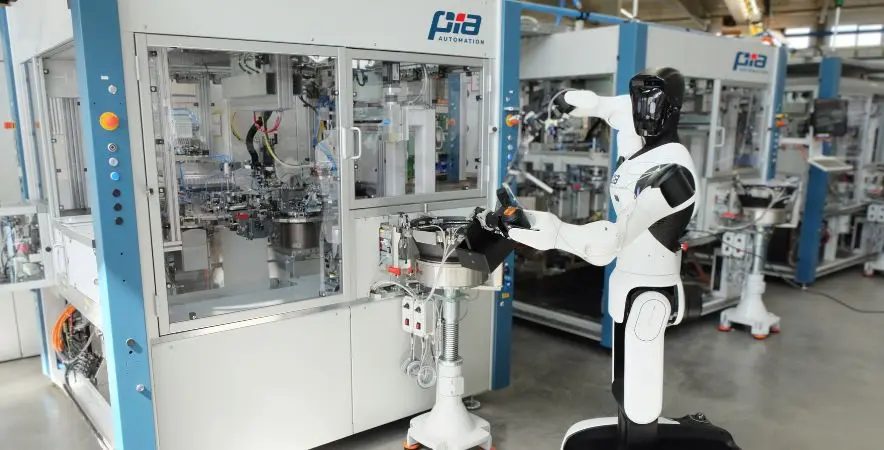
PIA Automation is testing the AgiBot-built humanoid on a relay line at Siemens' Amberg plant, carrying bins to the feeder on a six-minute cycle.
PIA Automation and Siemens are testing a humanoid robot on a live production line at Siemens' plant in Amberg, Germany, in the first trial of AI-driven humanoid robotics in a real manufacturing environment at PIA. The I-Bot 2.0, built for industrial work, has taken over the manual job of feeding a relay line with connector contacts and plastic housings.
The task is simple for a person and demanding for a humanoid. The robot drives to a bin of parts, picks it up, carries it several meters, empties it into the line's feeder and returns the empty bin to the pickup station. A full cycle is currently set at six minutes. PIA says the first goal is proving the system can do the job precisely and reliably over time — process stability and equipment availability come before throughput.
PIA acts as the project's system integrator, while the hardware comes from AgiBot, its joint-venture partner in Ningbo Joybot Robotics. For perception the robot combines 3D cameras with LiDAR, plus distance, force and pressure sensors to grip parts safely. Each robot is programmed individually, like a conventional industrial robot, while object recognition runs on a vision system PIA trained on its own dataset, transferable to other I-Bot units with minor adjustments.
Stefan Schneeberger, the PIA software engineer who co-leads the proof of concept, said six-axis robots still carry heavier loads and run faster cycles, but the humanoid's advantage is flexibility: it can move between work areas and switch tasks as needed. Siemens managers and production employees have given consistently positive feedback on progress under real production conditions, PIA said.
The next step is connecting the humanoid directly to the line's control system, so it starts and stops on its own when the line signals it needs parts. “Our plan is to bring this industrial application to full deployment readiness in the first half of 2027,” said Dr. Quanji Cai, PIA's head of Physical AI and Humanoid Robotics Europe. Cai said the aim is to extend conventional automation rather than replace it, putting humanoid flexibility where it creates industrial value and other solutions reach their limits.
PIA has worked on humanoid robotics since 2024 and grouped it into a dedicated business segment in early 2026. The I-Bot 2.0 was jointly launched with AgiBot in October 2025, and Joybot expanded capacity to more than 3,000 units a year; first field trials ran in December 2025 at a Joyson Safety factory. In parallel, PIA is industrializing its own MotionFlow Line, a fully automatic line for battery management systems where several I-Bot 2.0 robots handle transport and parts at assembly, end-of-line and labelling stations. A first section was shown at the World Artificial Intelligence Conference in Shanghai in July 2026, and a market-ready version is targeted for the first half of 2027.