Ant Lingbo Open-Sources LingBot-Touch, a Tactile Model That Gives Robot Hands a Sense of Touch
Trained on nearly 5,000 hours of touch data, the open model lifts dexterous task success by up to 26 points.
Ant Group's embodied AI unit Ant Lingbo has open-sourced LingBot-Touch, a pretrained tactile foundation model that gives robots a sense of touch to go with vision. Trained on nearly 5,000 hours of real tactile data, the model turns signals from different touch sensors into one shared representation that dexterous hands and action models can use.
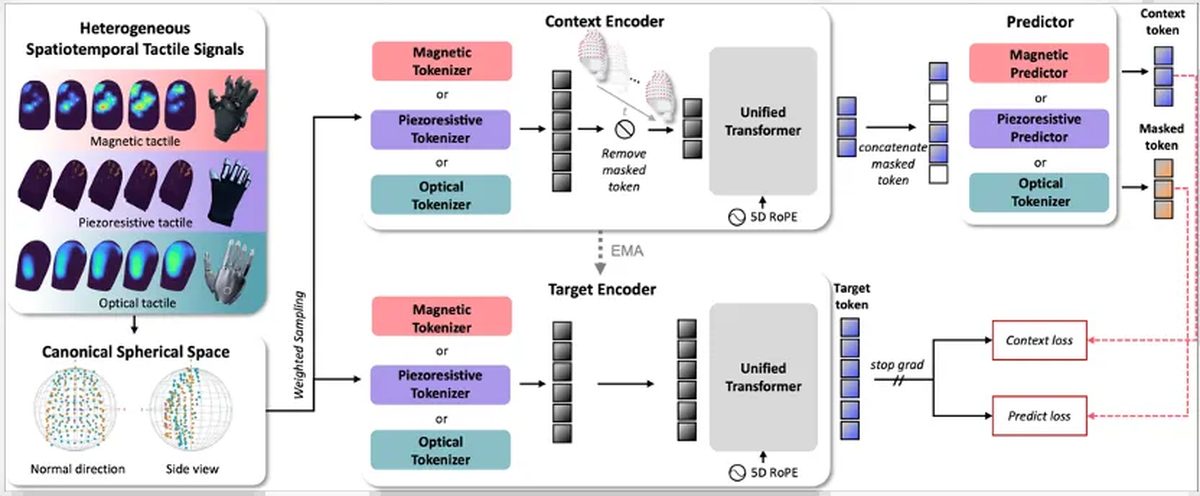
The problem it attacks is fragmentation. Magnetic, vision-based and piezoresistive sensors all speak different languages, so every new hand or sensor has meant rebuilding the touch pipeline from scratch. LingBot-Touch encodes each sensing principle separately, maps contact points from different layouts into a unified fingertip coordinate space and outputs common tactile tokens, so data from sensor gloves and teleoperated hands can train the same model.
In 26 real-robot tasks across two dexterous hands, Sharpa Wave and XHand1, covering page turning, bottle-cap unscrewing and mahjong tile recognition, adding the model lifted average success rates by about 14 to 26 percentage points over running without touch, across four action models including LingBot-VLA, π0.5, Diffusion Policy and T-Rex. The sharpest example came from T-Rex driving Sharpa Wave to unscrew a bottle cap: 56.25% success with no touch, 62.5% on raw sensor signals, and 90% with LingBot-Touch.
The release comes in two sizes. The smaller Tiny version, about 5.3 million parameters, ran all 26 tests and added only about 0.13% to 0.16% to the parameter counts of the action models it plugged into. Ant Lingbo also showed the model working on hardware it never trained on: the magnetic sensor type used by XHand1 was absent from the pretraining data, yet the model transferred with its parameters frozen. The model, code and a technical report are published on GitHub, Hugging Face and ModelScope, as the company pushes its LingBot series toward what it calls one brain for all robots.