Astribot Takes Three Papers to CoRL 2026 on Robots That Learn From Their Own Mistakes
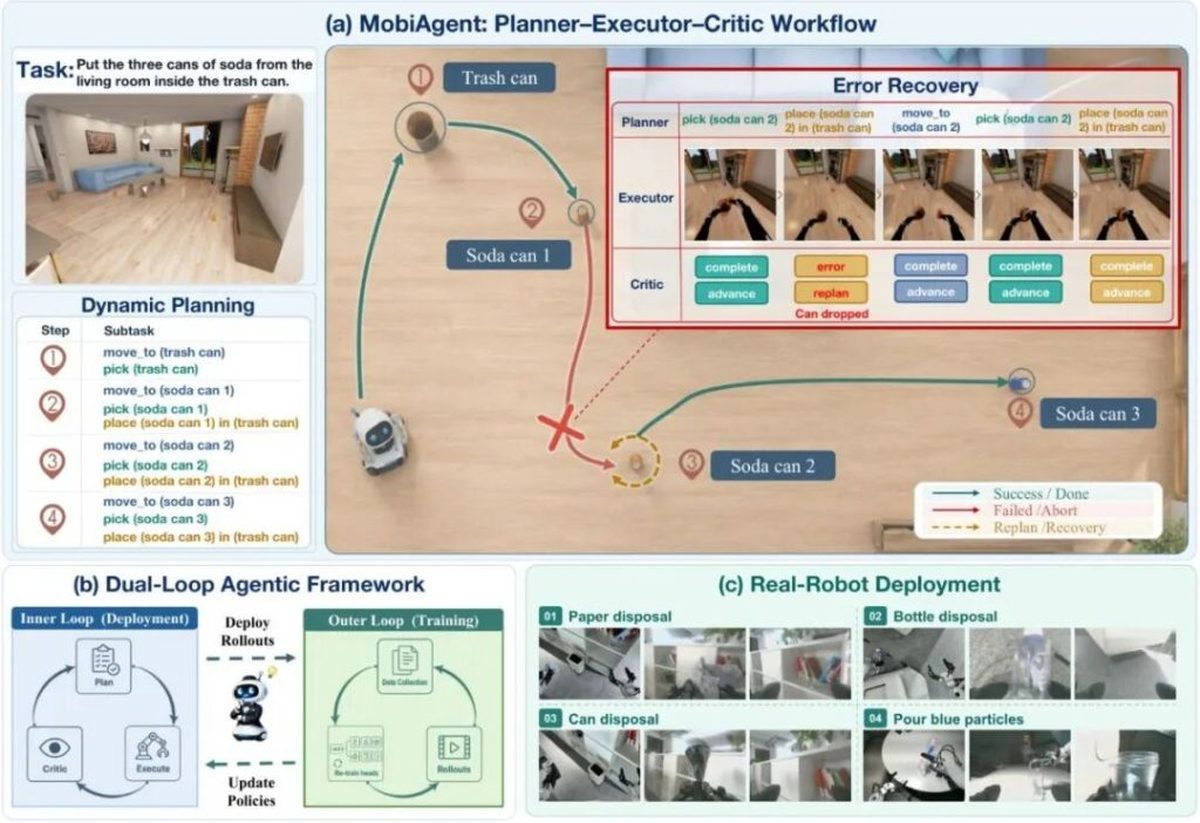
MobiAgent, PLaW-VLA and ARMS tackle long-horizon tasks, world models and always-on operation, with real-robot results to back them.
Astribot will present three papers at the 10th Conference on Robot Learning (CoRL 2026) in Austin this week, taking on three problems general-purpose robots still trip over: improving on their own during deployment, predicting what happens next, and staying switched on for long jobs. The papers were co-authored with researchers from the University of Hong Kong and the University of Tokyo, among others.
The lead paper, MobiAgent, gives a mobile manipulator a second loop for self-improvement. While the robot works, a vision-language model plans, skill experts execute and a reflection module checks results and triggers replanning when something goes wrong — if it drops a can, it goes back and picks it up instead of carrying on. Offline, the system sorts its own deployment data by skill and uses it to improve, without manual labelling. On BEHAVIOR-1K long-horizon tasks it averaged 65.0% success, which the company says is 22.5 points above the winning solution in the 2025 BEHAVIOR Challenge; on Astribot's S1 humanoid, two rounds of autonomous data collection lifted success on four long-horizon tasks from 32.5% to 57.5%.
The second paper, PLaW-VLA, builds a world model in latent space instead of reconstructing pixels, predicting the task-relevant future states an action policy needs. It beat π0.5 by 11.8 percentage points on the hardest long-horizon task group in RoboTwin 2.0, scored 72.7% on the LIBERO-Plus zero-shot generalization benchmark, and ran at about one-nineteenth the inference latency of generative world-action models at similar performance.
The third, Watch, Recall, Act, proposes ARMS, a streaming policy for robots that never clock off: visual triggering, proprioceptive state description and self-action memory run asynchronously, so a robot can use an idle arm to answer a new request while remembering which hand handled which object and when. It scored 45% in a comprehensive task evaluation against 28% for the strongest baseline, with 60% historical action recall and 67% task retention in real-robot tests running uninterrupted for more than ten minutes.