GenRobot's New Training Hardware Gives Robot Hands a Sense of Touch
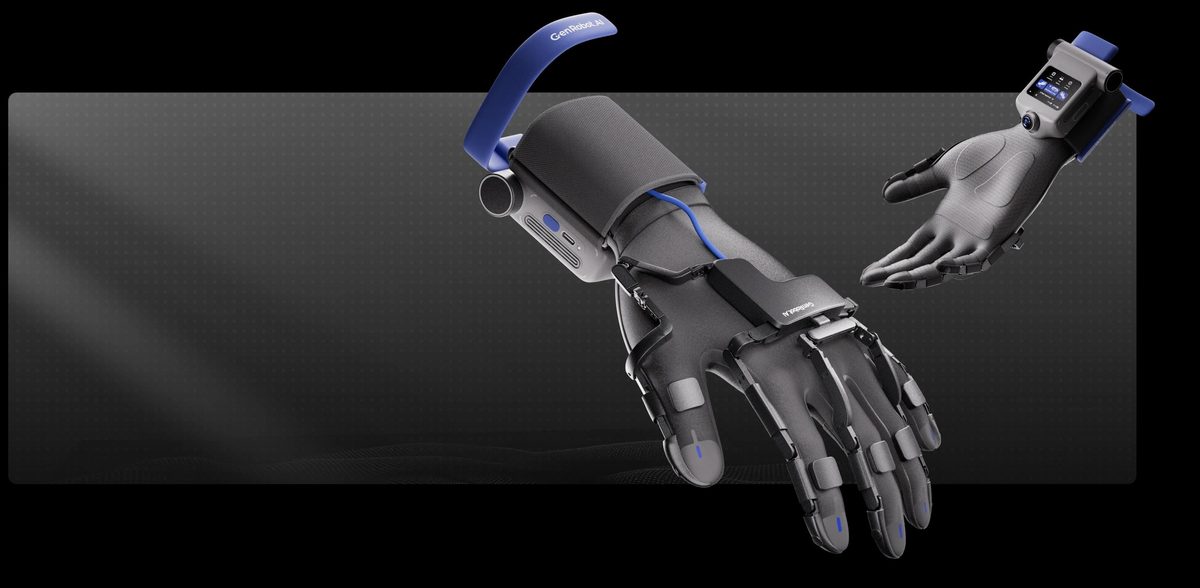
The DAS 2.0 series pairs a tactile glove that feels forces as light as 0.1 N with a head-mounted camera rig to record human skills for robot training.
GenRobot has introduced DAS 2.0, a hardware series for recording human manipulation in the detail robots need to learn from it. The lineup pairs a tactile glove, DAS Dex 2.0, with a head-mounted camera device, DAS Ego 2.0, so vision, hand motion and touch are captured together and in sync.
Dex 2.0 tracks the hand in 21 degrees of freedom using miniature magnetic encoders and kinematic calibration. Each glove carries 16 tactile sensors with 980 sensing elements and can detect forces as light as 0.1 newtons. The sensing skin is a semi-flexible piezoresistive material, and a biomimetic exoskeleton mounted along the sides of the fingers stays out of the way when picking objects off surfaces or working in tight spaces. GenRobot says a month-long test confirmed consistent tactile readings across repeated movements.
Ego 2.0, the headset, carries two 5-megapixel main cameras and four 2-megapixel auxiliary cameras, widening the horizontal field of view from 270 to 340 degrees. It tracks fingertips to a nominal 4 millimeters and records at 30 frames per second, with hot-swappable magnetic battery packs that run about 2.5 to 3 hours each. A shared clock and hardware triggering hold head and hand alignment to about 1 millisecond. At a hand speed of 0.5 meters per second, a 1-millisecond offset is about half a millimeter of movement.
The two devices come in three combinations: Ego 2.0 alone for first-person video and trajectories; Ego 2.0 plus a wrist camera for close-up views of approach and finger adjustment; and the full set, Ego 2.0 plus wrist camera plus Dex 2.0, which adds direct joint and tactile measurements. That pairing matters because video alone cannot tell two similar-looking actions apart when the contact forces differ, and it cannot measure force at all. GenRobot says the system can deliver up to 1 million hours of effective training data, ten times the previous version — a company figure, not independently verified.
The launch follows GenRobot's $100 million Series A+ round disclosed earlier this month, as the Silicon Valley startup builds out data infrastructure for physical AI. Its pitch is that the bottleneck in robot training is no longer video — it is high-quality records of what hands actually feel.