ASUS Unveils Gallop, Its First Humanoid Robot, Built for Factory Work
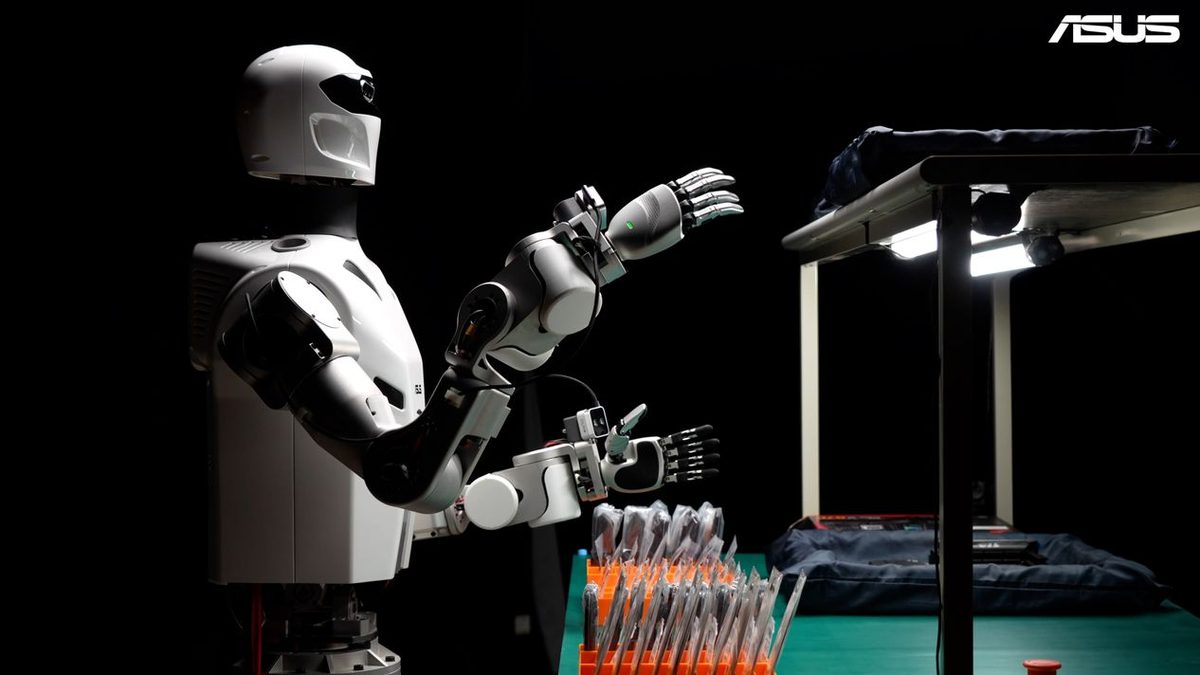
ASUS's first humanoid is learning to pack motherboard parts at a real factory station, with customer pilots planned for 2027.
ASUS has unveiled Gallop, its first humanoid robot, a machine built to do real work at a factory station rather than perform staged demonstrations. Co-CEO S.Y. Hsu introduced the robot on CNBC, and ASUS published details of the program on November 13. Gallop comes from the Humanoid Robotics business unit of the company's Physical AI Solutions Business Group.
Gallop's first job is packing motherboard accessories at an ASUS group electronics manufacturing services plant. The station handles 15 small parts, many of them sealed in thin, clear plastic bags, and takes about 20 seconds per board. ASUS set its bar at 99.5 percent success within 20 seconds, the standard it holds a human worker to. That figure is a target, not a result the company says it has reached.
Gallop learns the way a new colleague would. It starts from leading open AI models, watches skilled workers through head-mounted cameras worn with their consent, practices variations in simulation, and takes hands-on guidance from an operator in a VR headset and gloves working on the same parts. What it records on the job feeds back into training.
Inside, four software layers divide the work: a planner breaks jobs into steps, a supervisor checks each step and re-plans when something goes wrong, a skills layer handles reaching, grasping and placing, and a control layer moves the arms and hands and stops instantly if anything is wrong. Everything runs on a single Nvidia Jetson AGX Thor computer inside the robot. ASUS designs the body and the hand itself — the hand, with a sense of touch, is the hardest part, the company says — while motors and other standard parts come from established partners.
Today Gallop works from a fixed base with two arms; a wheeled version comes next. Over the coming year ASUS plans to fit its own dexterous hand, put Gallop on wheels and show it to customers at Computex 2027. Customer pilots are planned for 2027, with market availability targeted for the second half of 2028. The program began in early 2026. Electronics manufacturing comes first; the company sees the same pick-and-place skills carrying over to hospitals and service sites later.