EngineAI's Awaken-HI Trains the T800 on 50,000 Hours of Human Experience
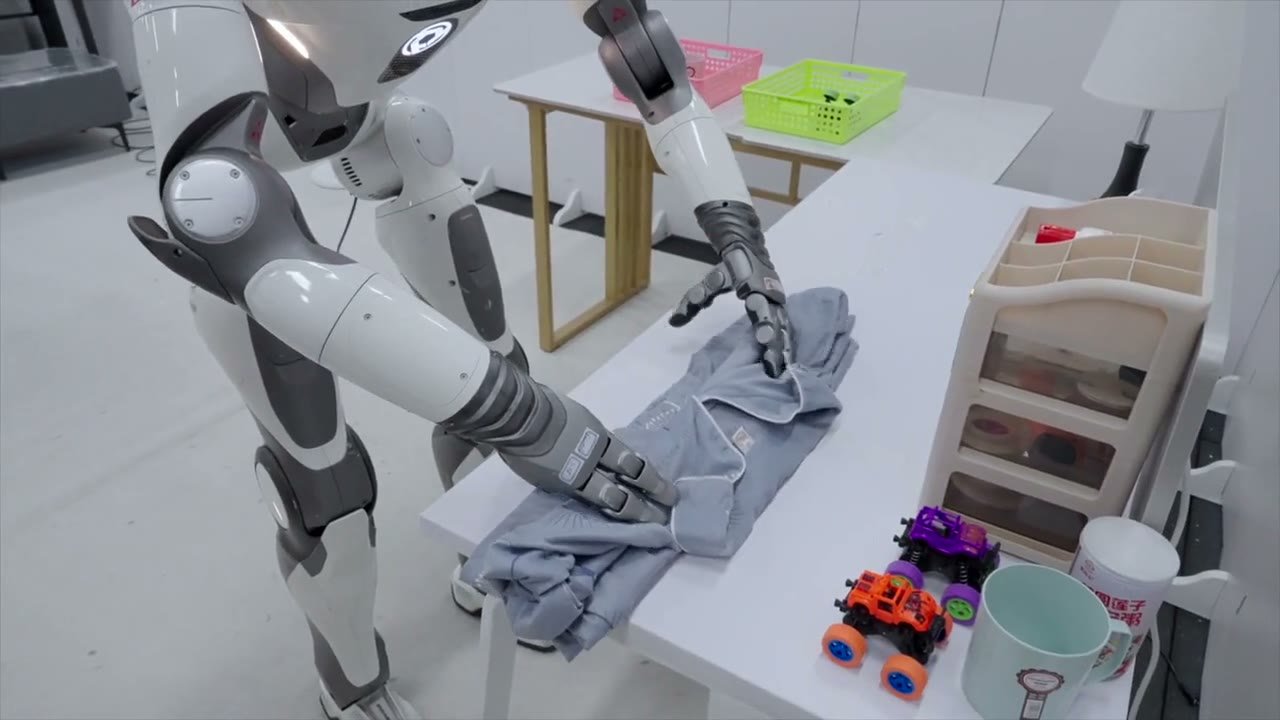
EngineAI's Awaken-HI learned from 50,000 hours of first-person human video, then taught its T800 humanoid to tidy rooms and stock shelves.
EngineAI has introduced Awaken-HI, a vision-language-action model that lets its T800 humanoid learn everyday tasks from watching people do them. The work was posted to arXiv on November 19, and the T800 runs the model to stock shelves in a warehouse and tidy up a room at home.
The foundation is a dataset called Awaken-Human: roughly 50,000 hours of first-person stereo video synced with whole-body human motion, covering more than 100 skills across homes, workplaces, retail spaces and storage areas. People recorded the demonstrations wearing a PICO headset and five body trackers, and the corpus holds 17.02 million episodes, 5.41 billion pose frames and 11.18 million language instructions.
Awaken-HI learns human movement and robot movement together. A shared action expert jointly predicts the original human motion and the retargeted robot actions, so the human trajectories directly supervise the network that drives the T800. The model builds on the Qwen3-VL vision-language backbone, and after pretraining on the human corpus it is fine-tuned on about 150 hours of T800 teleoperation data.
The results scale with the human data. Growing pretraining from 5,000 to 50,000 hours of demonstrations raised mean success on three household tasks from 56.7% to 90.0%. After full-corpus pretraining and T800 adaptation, Awaken-HI averaged 93.75% success across eight individual loco-manipulation tasks — walking to objects, picking them up, placing them on shelves, hanging a garment and moving a laundry basket — against 57.5% for pi-0.5 and 58.75% for GR00T N1.7, each trained on the same 150 hours of teleoperation. On long-horizon sequences it reached 90% on the industrial stocking task and 80% on household tidying.
The limits are worth stating plainly. Every result comes from a single robot platform, the T800, with ten trials per task, so each outcome swings a task score by ten percentage points. There is no independent reproduction yet, and the inference code, model weights and simulation platform are still listed as forthcoming. The model also only partly generalizes to objects it never saw in robot training: it completed tissues half the time and a medicine bottle 30% of the time, where both baselines scored zero. EngineAI, based in Shenzhen, builds the full-size T800 humanoid; the same robot danced in the city's 100-robot display during APEC week.