Eka Robotics raises $150M to give robots a sense of touch
The MIT-born startup's vision-force-action model skips human demos and trains in simulation — and a16z and F-Prime just valued it at $1.45 billion.
Eka Robotics, a Cambridge, Massachusetts startup, has closed a $150 million Series A round that values the company at $1.45 billion post-money. Andreessen Horowitz and F-Prime, a fund affiliated with Fidelity Investments, co-led the round, with the seed backers Obvious Ventures and the E14 Fund rejoining alongside Samsung Next, MFV Partners, Bison Ventures, Glasswing Ventures and several Fortune 500 strategic investors.
The founders are Pulkit Agrawal, an MIT professor who runs a robot-learning lab at the institute, and Tuomas Haarnoja, a former Google DeepMind researcher who co-created Soft Actor-Critic, a widely used reinforcement-learning method. The two first met as graduate students at the University of California, Berkeley.
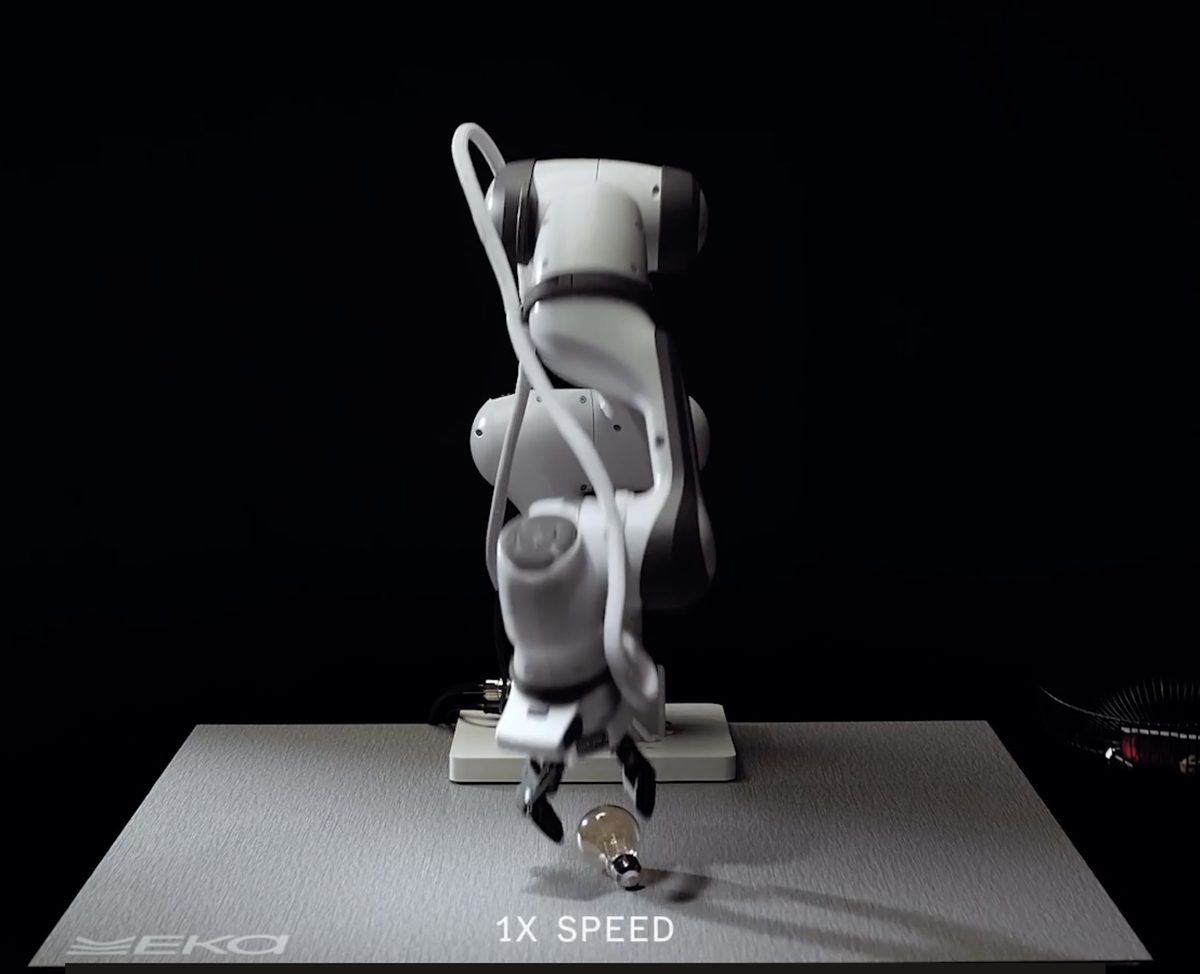
Eka's pitch is that robot hands need a sense of touch, not just better eyes. Its vision-force-action model pairs cameras with a dense network of force sensors in a purpose-built gripper: vision gets the robot roughly to the object, and force feedback closes the last millimeter — feeling slip, fragility and contact pressure so the machine can adjust mid-grasp instead of failing. The gripper costs less than $1,000, the company says.
The training method is the real break with the field's current playbook. Where companies like Physical Intelligence and Skild AI teach robots by imitating tens of thousands of human teleoperation demonstrations, Eka runs millions of trial-and-error grasps inside a physics simulator and learns by reinforcement — generating what the company describes as thousands of hours of robot experience in minutes, with no human demos at all. The company reports about 1,500 picks an hour on objects up to a kilogram, versus roughly 600 for a human worker, at a success rate above 95%.
‘Vision is not the primary way in which you close this last millimeter problem,’ Agrawal said in an interview with TechCrunch. ‘Vision tells you roughly where the object is, what the pose is, but the actual grabbing, the actual searching is happening through forces.’
The leap from lab to line is still ahead of it. Eka is running pilots with industrial customers on pick-and-place and wire handling, but a year of failure-free shifts on a real assembly line — and proof the technique generalizes beyond pick-and-place — are the open tests. The gripper is currently rated for 5 million duty cycles; the company wants to reach the 20-million-cycle bar set by standard industrial arms.