HKU's PhysicalRSI 1.0 beats GPT-6 Astra on RoboDojo at 1% of the cost
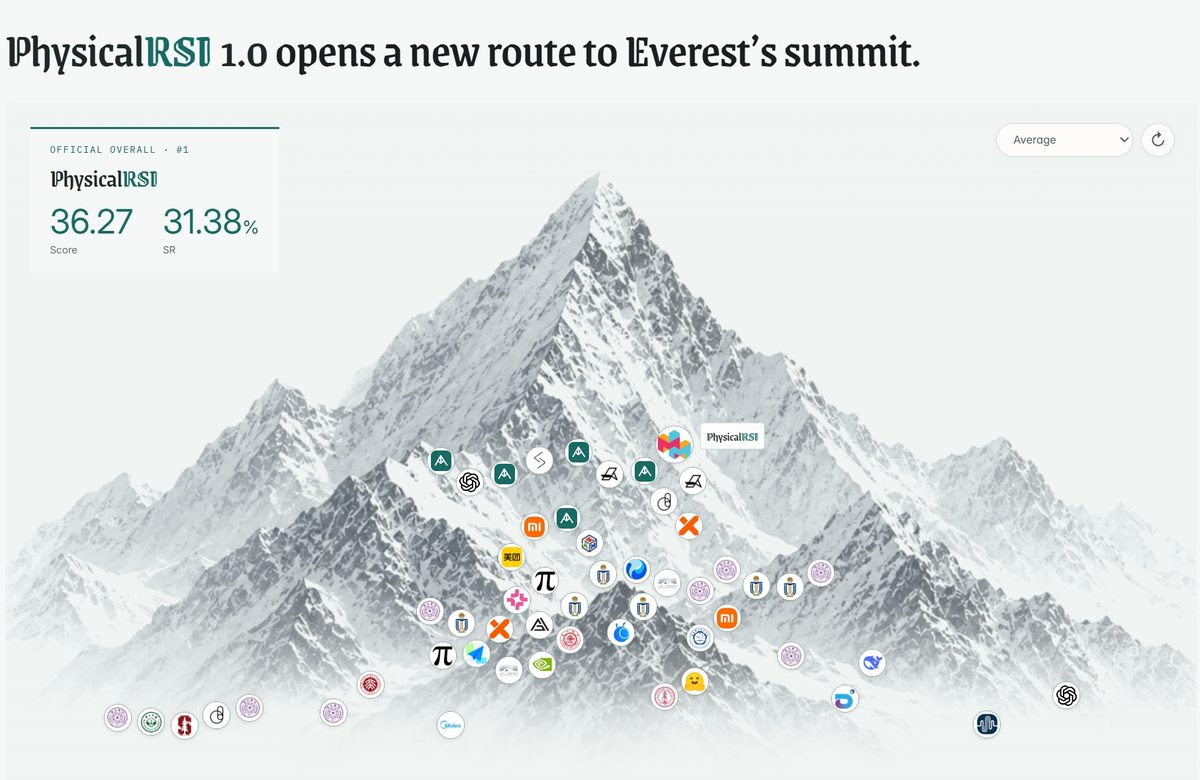
Self-evolving embodied AI: it freezes the foundation model and evolves the agent's harness — 31.38% success vs Astra's 22.21%.
A research team at the University of Hong Kong's MMLab has proposed PhysicalRSI 1.0 — short for Physical Recursive Self-Improvement — a simple self-evolving baseline for embodied AI that has taken first place on the RoboDojo benchmark with a 31.38% average task success rate and a 36.27 score, at roughly 1% of the token cost of GPT-6 Astra. Astra scored 28.86 with 22.21% success; a full RoboDojo run reportedly costs it about 200,000 yuan in tokens.
The design is a 'System 1–2 Co-Evolution' split. A general multimodal foundation model acts as System 2: it analyzes task failures and rewrites the harness — the agent's working program that ties together tools, code, memory and skills. A separate execution layer, System 1, carries out the physical actions. Candidate variants are evaluated in the physical environment, and the better performers are retained for the next generation. Crucially, the foundation model's weights stay frozen; what evolves is the harness configuration.
The contrast with end-to-end giant models is sharpest on precision work. Astra's precision-operation success rate was only 4%, versus 32.5% for PhysicalRSI. On key insertion, PhysicalRSI succeeded 39.33% of the time across three seeds, while Astra, π0.5 and Simate-beta all scored zero. On tube insertion it reached 66% against 0–22% for the comparators; on block swapping, 92.67% versus 18% for Astra and 0.67% for π0.5; on a memory-dependent cover-lifting sequence, 100% versus Astra's 46%.
It also improves itself. Across five checkpoints of a cloth-folding task, the success rate climbed from 27.5% to 60% and the score from 31.5 to 61.5, with different generations exploring retraction paths, wrist alignment, target selection and cloth tracking.
The argument the team is making is a route dispute: instead of scaling a single end-to-end model, freeze the model and let the agent program around it evolve through physical trial and error. The group positions PhysicalRSI 1.0 as research infrastructure — a baseline with unified interfaces for models, VLA systems, tools and physical environments, plus lineage tracking for candidate agents — and says it plans to extend the framework to more robots and harder tasks. The code is public.
One caution: these are the team's own benchmark numbers, and independent replication is the real test. But the leaderboard position and the cost gap are the kind of result that forces the bigger-model labs to answer.