Unitree's Guardian V3.0 Copies a Human Operator in 80 Milliseconds
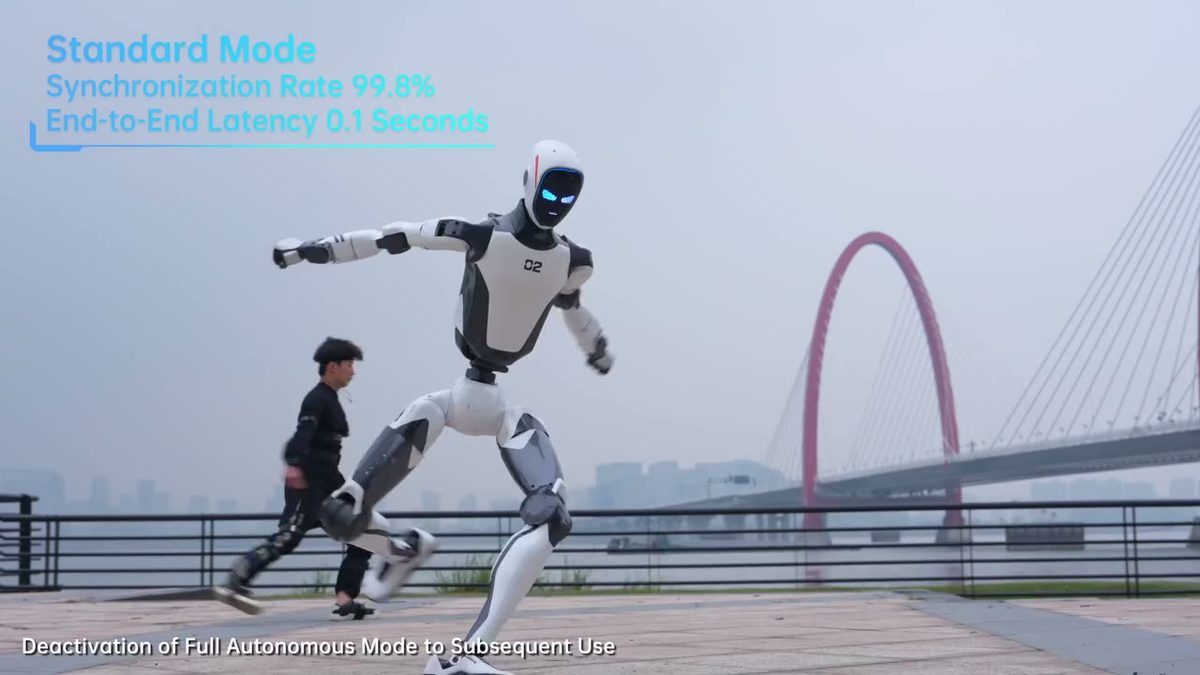
Unitree's third-generation Embodied Avatar system maps a motion-capture operator onto its G1 humanoid, at 99.8% sync and 80ms of lag.
Unitree has unveiled Guardian V3.0, the third generation of its Embodied Avatar teleoperation system, which lets a human operator drive a humanoid robot's whole body in near real time. In a demonstration video released on Friday, an operator in a motion-capture suit steers a G1 humanoid through kicks, jumps, backflips, boxing stances and dance moves outdoors, while the robot mirrors each movement with almost no visible delay. An indoor segment shows the same setup tracking the operator's hands and fingers.
Guardian is a control system, not a new robot: the demonstrations use Unitree's G1 humanoid. The system runs in two modes. Standard Mode holds synchronization at 99.8 percent with end-to-end latency of 0.1 seconds, while Motion Mode trades a little accuracy for speed, at 99.5 percent synchronization and 80 milliseconds of latency. The video opens with the robot switching out of autonomous mode into operator control.
Those figures are Unitree's own claims, and the company has not published the test conditions behind them: how synchronization is defined, which stages of the control loop the latency figure covers, or the network and hardware the tests ran on. Pricing, a release date, supported motion-capture hardware, developer interfaces and safety controls are also undisclosed so far.
The pitch is less about the stunts than about what teleoperation is for. Unitree positions Guardian for remote work in hazardous settings, supervised deployment, and evaluating autonomous policies against a human-operated baseline. Most consequential is data collection: every operator session records commands and sensor readings directly on the robot, turning human demonstrations into training trajectories that already respect the machine's joint limits, balance and actuator strength.
That data angle is where the humanoid race is quietly being decided. Autonomous policies need demonstrations that match the target robot's body, and video imitation or simulation both introduce mismatches that teleoperation avoids. Rivals are building the same loop: 1X offers an Expert Mode for its NEO home robot, and Unitree links Guardian to its UniFoLM framework for learning and control. Earlier Embodied Avatar demonstrations showed G1 robots playing soccer, sparring and boxing under motion-capture control.
For now Guardian is a demonstration with numbers attached, not a product with a price. Its test will be whether Unitree opens it to developers with published benchmarks and safety behavior, and whether the demonstrations it collects turn into robots that can work without a human in the loop.