Unitree and PetroChina parent CNPC form joint venture for industrial robots in oil and gas
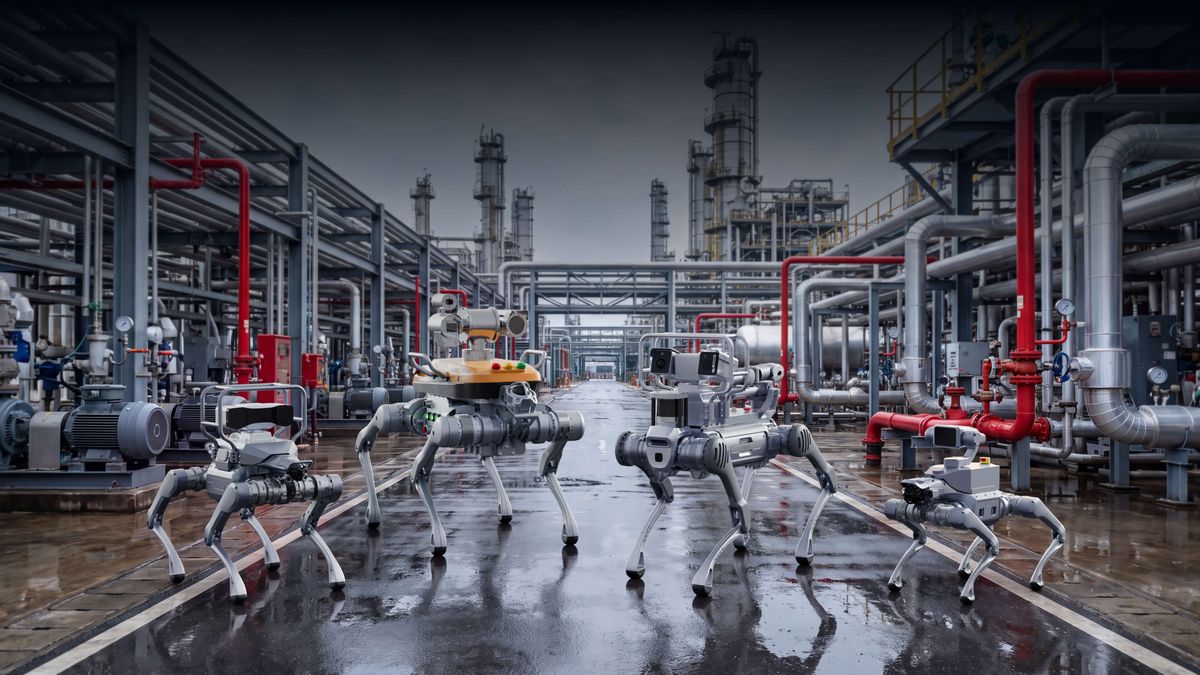
The venture pairs Unitree's robots with CNPC's energy sites, giving the robot maker its first major state-owned partner since the US blacklisted it.
Unitree Robotics has agreed to form a joint venture with China National Petroleum Corporation (CNPC) to build industrial robots for oil and gas sites, the first major partnership the robot maker has struck with a state-owned enterprise since Washington labeled it a Chinese military company. A filing with the Beijing Administration for Market Regulation shows CNPC's Kunlun Manufacturing and its investment arm Kunlun Capital will hold 60 percent of the new company, with Unitree and Beijing Fanjie Intelligent Technology holding 20 percent each. The three parties will jointly control the venture.
The venture will develop industrial embodied-intelligence robotics for inspection and emergency response at oil and gas facilities, refineries, chemical storage and transport sites, gas stations and integrated energy stations. The filing entered a public comment period on November 4 that runs until November 13, and the new company has not yet completed business registration. Its name and location have not been disclosed.
The deal builds on a relationship that predates the filing. Kunlun Capital was a strategic investor in Unitree's Shanghai STAR Market listing in August, taking 903,290 shares, or 2.23 percent of the strategic placement, and the two sides have signed a memorandum of understanding on robots for oil and gas work. Unitree listed on August 19 and raised RMB 6.1 billion, about USD 900 million.
Unitree already sells hardware suited to the venture's target sites. Its B2-Ex is an explosion-proof quadruped built for gas-gathering stations, production zones and chemical tank farms, carrying inspection payloads that include thermal imaging and gas sensors. Access to live energy sites would also give Unitree real operating data from the hazardous environments its robots are designed for.
The venture lands as Unitree's position in the United States tightens. The Pentagon added Unitree to its 1260H list of companies it says support China's military on June 8, and the Federal Communications Commission put foreign-built advanced robots on its Covered List on July 28. Unitree has told investors its six best-selling models, the G1, H2 and R1 humanoids and the Go2, B2 and A2 quadrupeds, passed FCC authorization before the rule took effect and can still be sold, while new models would need an exemption. Overseas sales account for more than 40 percent of Unitree's revenue, while the US share has fallen to 13.3 percent.