T-Mobile is testing whether Figure's humanoid brains can run at the network edge
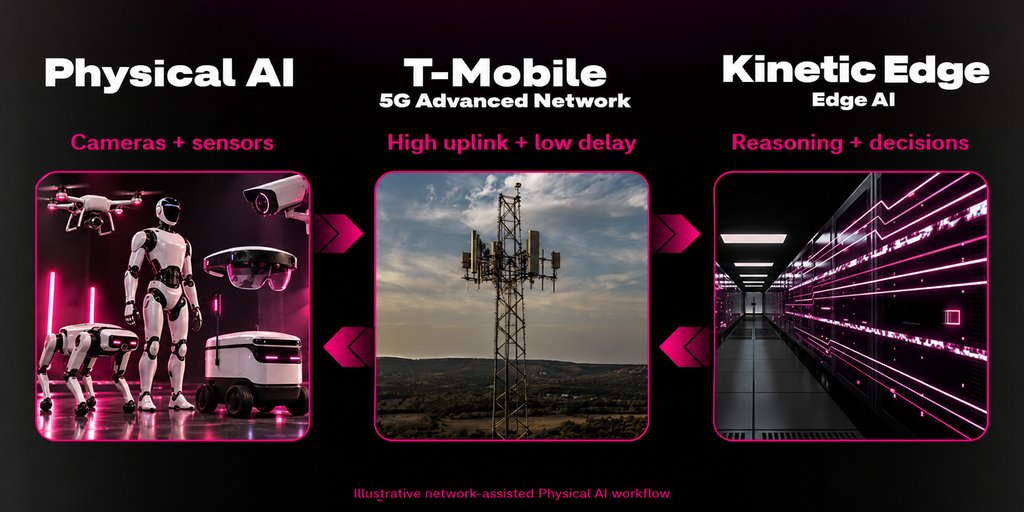
T-Mobile and Figure AI are testing whether parts of Figure's Helix models can run on edge compute, instead of only inside the robot.
T-Mobile is testing a different place to put a humanoid robot's brain: the network. In a new blog post, the carrier's chief technology officer John Saw said T-Mobile and Figure AI are assessing whether portions of Figure's Helix S1 and S2 models can run on compute closer to the network edge while keeping the responsiveness a moving machine needs. The work builds on an existing relationship that started with eSIM connectivity for Figure's robots and continued through the training loop. Now, Saw wrote, the companies are testing whether the network itself can help deliver the intelligence.
The argument is about tradeoffs, not raw power. A bigger onboard model makes a robot smarter, but it also has to be carried: more batteries, more heat, more weight, more cost and less run time. If part of the thinking happens nearby on the network instead, the robot could tap more capable AI without growing proportionally heavier or more power-hungry. For a machine that must see, decide and move in real time, the question is whether the round trip to the edge is fast and reliable enough to be invisible.
The Figure test is one strand of a wider program. T-Mobile is working with Serve Robotics on an edge-based supervision layer for sidewalk delivery fleets, where human attention becomes the bottleneck once hundreds of robots become thousands. It is also working with the City of San Jose on 5G-connected cameras and edge AI that stitch single intersections into a wider picture of traffic. Underpinning all of it is Kinetic Edge, a distributed intelligence infrastructure T-Mobile is building with Amazon Web Services, combining its 5G Advanced network with AWS cloud orchestration and AI services.
This is early work, not a deployment. T-Mobile describes the Figure effort as assessing and testing, gives no performance numbers and sets no timeline, and the same caution applies to the fleet and city projects. The significance is architectural: a major carrier is now treating the network as part of a robot's computing stack, not just its connection. If edge inference proves fast and dependable in the field, it could change how much hardware a humanoid needs to carry. If it does not, the robot's own computer remains the limit.