South Korea opens a factory that makes training data for humanoid robots
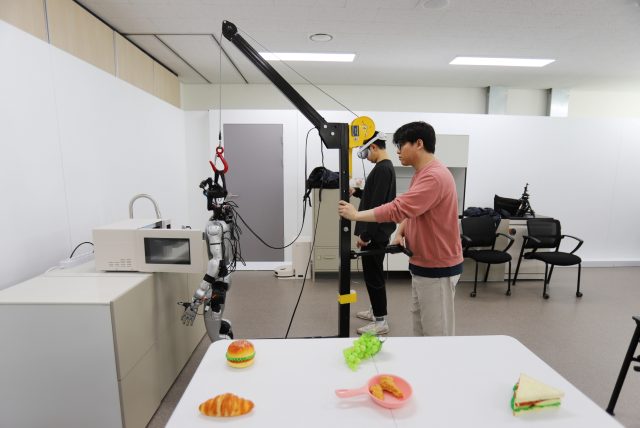
The Daejeon facility runs 12 humanoids that record household tasks to train vision-language-action models, part of a national K-Moonshot push.
South Korea has opened its first facility built to mass-produce training data for two-legged humanoid robots, a state-backed bet that the hardest part of building a useful humanoid is no longer the body, but the data that teaches it to work. The AI Humanoid Data Factory, run by the Korea Institute of Machinery and Materials (KIMM) with the Electronics and Telecommunications Research Institute (ETRI), opened Tuesday in Daejeon.
The factory runs 12 humanoids across about 1,000 square meters on two floors of a KIMM building, with plans to expand to 25 robots. Researchers steer the machines by remote control through everyday jobs — pulling items from a refrigerator, handling laundry, tidying a sofa, working the buttons and levers inside a car — and every movement is recorded. The recordings train vision-language-action models, systems that turn what a robot sees and is told into movement. Trained models go back into the robots for testing, and data from those runs feeds the next round of training.
KIMM president Ryu Seog-hyeon said securing large-scale, high-quality robot task data is the core of national technological competitiveness, and the institute said the facility should reduce dependence on foreign data and AI models.
The project sits inside K-Moonshot, the Ministry of Science and ICT program applying AI to 12 national missions, including humanoids. The ministry aims to field a world-class national humanoid platform within three years, with its Next-X Humanoid Challenge set to make its final pick from 2027. In August, the Ministry of Planning and Budget earmarked 2.3 trillion won ($1.7 billion) through 2030 for the humanoid industry, a plan that includes buying 1,080 domestic humanoids and raising the local share of core parts to 80 percent from about 45 percent.
KIMM also showed its own humanoid, KAIROS, at the opening ceremony. The institute began building KAIROS a little over a year ago; the machine demonstrated precise object handling and whole-body motion imitation, and its first version is due in April 2027. The factory will open in stages to companies, universities and research institutes from late 2027.