Safeworld emerges from stealth with a $12M-plus seed round to stress-test AI-driven robots in simulation
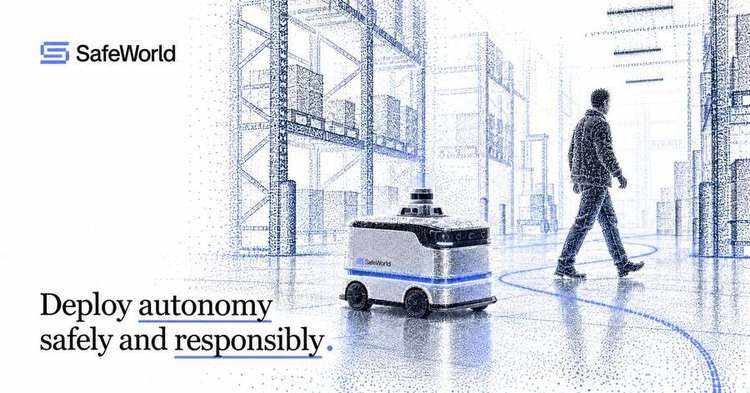
The CMU spinout wants to be the independent safety lab for robots working around people, running a customer's own control software against crowds of simulated humans before deployment.
Safeworld, a Palo Alto startup built on Carnegie Mellon robotics-safety research, emerged from stealth on October 5 with a seed round of more than $12 million, first reported by TechCrunch. The round was led by Shine Capital and Andreessen Horowitz's Speedrun program, with Box Group, the Carnegie Mellon University Endowment, Innovation Endeavors and SV Angel participating. The company disclosed neither the exact total nor its valuation. It was founded in 2025, according to the a16z Speedrun company listing.
The product is a safety-testing layer for robots that operate around people. Safeworld reconstructs a customer's physical site as a digital twin — built on the Genesis and MuJoCo simulation frameworks — drops in a model of the robot running its actual control software, then floods the scene with simulated people of varying size, shape and behavior: kneeling, tripping, running, carrying boxes around a factory blind corner. The bet, in the founders' telling, is that as generative AI takes direct control of physical machines, robot makers will need an independent way to probe how those systems behave before they enter workplaces and homes. A passing scripted demo, they argue, says little about what happens when visibility changes or a person wanders into the machine's path.
The founding team stitches together the three halves of the problem. Ding Zhao directs CMU's Safe AI Lab and has spent his research career on trustworthy AI and physical human-robot interaction. Kyle Wong co-founded the startup Pixlee and later became CEO of Stanford's StartX accelerator. Simo Rachidi worked with Wong at Pixlee and brings machine-learning and cybersecurity experience from Salesforce Einstein. An early collaboration named in the reporting is Gritt Robotics, whose machines assist workers installing photovoltaic panels at industrial-scale solar farms; its CTO told TechCrunch that proving safety through formal mathematical verification is difficult, which is why empirical testing matters.
The raise lands in the middle of a busy month for robot safety. It follows Agility Robotics' partnership with FORT Robotics to build a safety architecture for the Digit 5 humanoid and NVIDIA's open safety platform for AI agents — all of them circling the same gap: humanoids are leaving their safety cages for warehouses, factories and sidewalks, and neither regulators nor buyers have a settled way to verify what 'safe enough' means. Two caveats belong with the announcement. First, everything about Safeworld's method — including whether simulated encounters actually predict real-world behavior — is the company's own framing; no independent results have been published. Second, the reporting does not establish whether the Gritt Robotics work is a paid engagement, a production deployment, or validated safety evidence yet.