Rendezvous Robotics raises $20M to build spacecraft that assemble themselves in orbit
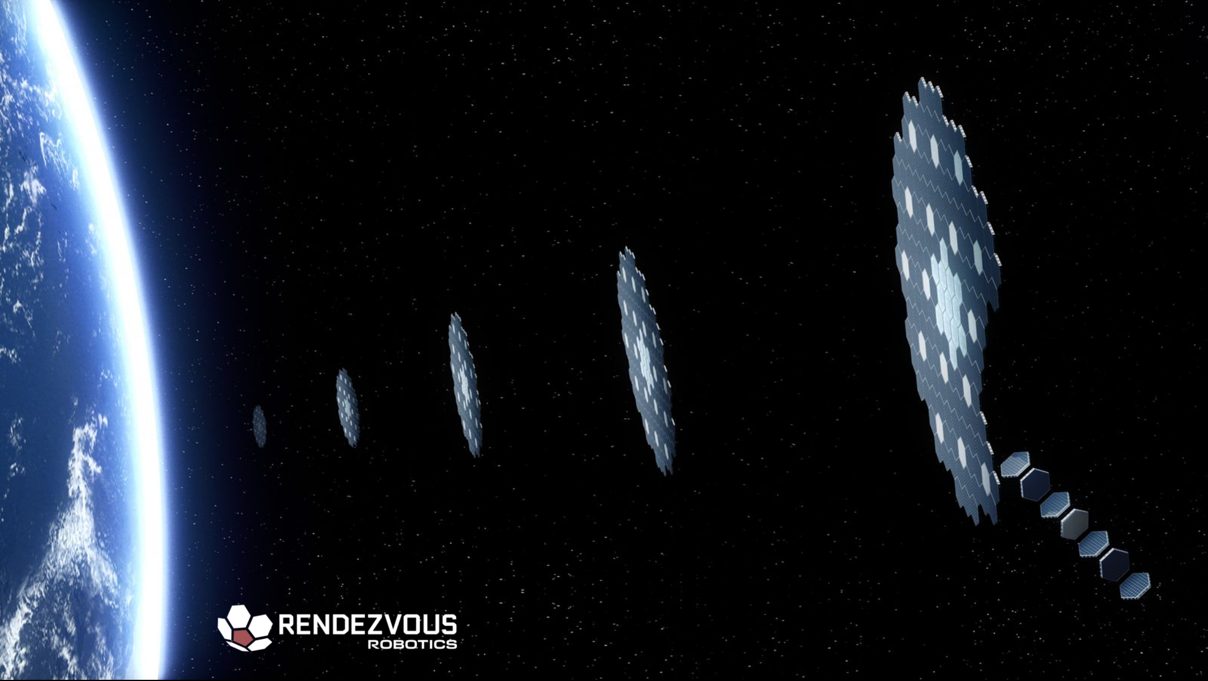
MaC Venture Capital and Toyota Ventures led the oversubscribed seed round for modular spacecraft tiles that assemble themselves in orbit.
Rendezvous Robotics has raised an oversubscribed $20 million seed round to build spacecraft that assemble themselves in orbit. MaC Venture Capital and Toyota Ventures led the financing, announced on October 28, the company's first priced funding round. The University of Michigan Endowment made a significant investment, joined by new investors Astera, Industrious Ventures, Humbition and NextView Ventures, and existing backers Aurelia Foundry, ATX Venture Partners and Mana Ventures.
The Golden, Colorado-based startup builds spacecraft from independent modular tiles, each roughly a meter across and carrying its own sensors and onboard processing. Launched separately, the tiles maneuver, align and connect autonomously in orbit, then reconfigure into a different structure when the mission changes. The approach attacks the oldest constraint in spacecraft design: everything must fit inside a rocket fairing, which caps power, compute, antenna size and heat dissipation before launch. Rendezvous argues that building in orbit, rather than packaging better for launch, removes that ceiling entirely.
The technology, called TESSERAE, began as modular self-assembly research invented by co-founder and board chair Dr. Ariel Ekblaw at MIT and developed further through the Aurelia Institute, which Ekblaw founded. Earlier generations have flown aboard Blue Origin's New Shepard rocket and on two missions to the International Space Station. The company is now developing a new generation of larger, independently operating tiles, with ground demonstrations underway to validate autonomous movement, alignment and assembly.
The funding will support development of the next-generation spacecraft, flight demonstrations and team expansion. A parabolic flight campaign in November 2026 will test mobility and electromagnetic actuation in microgravity, followed in December by a final ISS demonstration in which 32 fifth-generation TESSERAE tiles autonomously assemble into a three-dimensional structure. The headline test comes no earlier than April 2028, when seven independently launched tiles are scheduled to join into a single spacecraft in free space, separate, and assemble again in a different configuration, without external robotic assistance.
The bet is that autonomous in-orbit assembly turns spacecraft from fixed products into expandable platforms: megawatt-scale power, far larger sensing apertures, and hardware that gains capability after launch. The risk is execution on a long, capital-intensive road to 2028, with the technology still to prove itself outside controlled demonstrations. Rendezvous has narrowed its near-term focus to satellites, where the tile architecture can reach orbit soonest. A $20 million seed round, oversubscribed on a first priced raise, says investors are willing to fund the climb. The proof will be the December ISS demonstration, and then the 2028 mission that has to assemble, separate and reassemble on its own.