Physical Intelligence opens Pi API beta, takes robot brains to factory floors
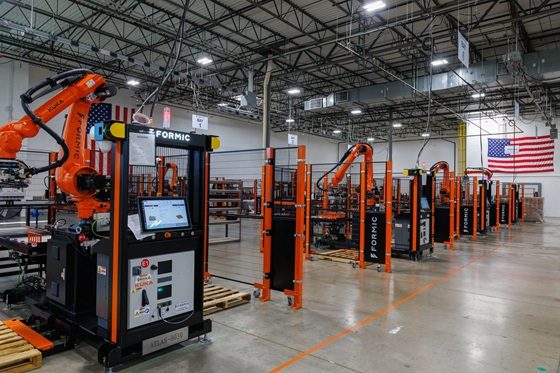
Developers can now fine-tune π0 and π0.5 on managed infrastructure — and Formic is deploying the models across 150 factories.
Physical Intelligence has opened a beta of its Pi API, letting outside developers run the training loop behind its general-purpose robot models themselves. Announced October 13, the API lets teams upload demonstration data, fine-tune π0 and π0.5 on compute and infrastructure the company manages, and serve the resulting models through a hosted gateway for inference. Access is waitlisted: applicants are asked to describe what they want to build.
The company showed early results from a small group of early-access users. Almond, a San Francisco startup building the dual-arm Axol robot, had its machine deburring spacers used in its own assembly after four days of iterating with the API. Actor, a heavy-machinery developer, ran an autonomous wheel loader scooping material and loading dump trucks in a commercial deployment with no operator aboard. The intended loop is explicit: collect demonstrations, train a model, test it on the robot, and use the failures to decide what data to collect next. Most early applications ran on cloud-hosted inference, and the company acknowledged network connectivity posed challenges for some deployments.
The factory angle came from Formic. Founder and CEO Saman Farid said his company is working with Physical Intelligence to bring general-purpose robot models into the factories that need them most, noting 150 factories are already using Formic robots — and counting. Formic sells robots-as-a-service to US manufacturers, which makes it a natural distribution channel for a model that claims to be hardware-agnostic.
The strategic bet is the decoupling of robot intelligence from the robot body: one foundation model that can be downloaded into many different machines, shifting value toward the software layer. Physical Intelligence characterized the effort as still early, with developer feedback set to shape future releases — and left pricing, GPU allocation, and commercial terms undisclosed.