MIT Technology Review: AI breakthroughs won't make humanoid robots useful anytime soon
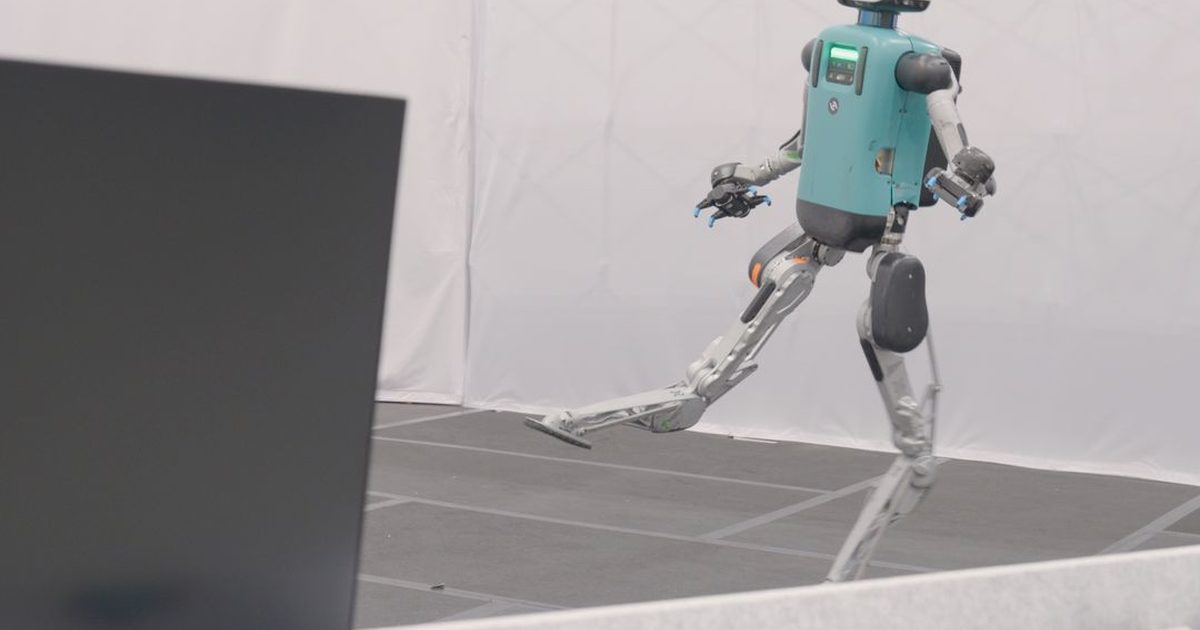
A new feature takes stock of the gap between dazzling demos and working machines: VLA models fail outside their training data, world models are nascent, and a fully autonomous household humanoid is a decade out, leading roboticists say.
MIT Technology Review published a major feature on October 8 arguing that the AI advances fueling robotics hype have not brought genuinely useful humanoid robots meaningfully closer. The piece, a collaboration with the Aventine research foundation, contrasts the industry's biggest promises with what the machines can actually do: Elon Musk calling Tesla's Optimus "not just Tesla's biggest product ever, but probably the biggest product ever," priced near $20,000 and promised for public sale by the end of 2027; Marc Andreessen calling robotics potentially "the biggest industry in the history of the planet"; Nvidia's Jensen Huang saying humanoids would match human-level ability this year; and Morgan Stanley projecting nearly a billion humanlike robots by 2050 in a market worth over $5 trillion.
The skeptics have the floor. Yann LeCun, one of the godfathers of modern AI, said at the Davos conference that none of the humanoid companies has "any idea how to make those robots smart enough to be useful," and argued that AI approaches successful for language "do not work for high-dimensional, continuous, noisy data" — the kind robotics runs on. Jonathan Hurst, cofounder and chief robot officer of Agility Robotics and a robotics professor at Oregon State University, put it this way in an interview with MIT Technology Review: "It's very easy to make a robot that looks like a person. It is dramatically more difficult to make a machine that moves or behaves dynamically or physically like a person."
At the technical core is the vision-language-action (VLA) model, which converts vision and language input into motor commands. Google DeepMind's Gemini Robotics VLA, tested on the ALOHA 2 bimanual rig, can pack a lunchbox — placing bread in a bag, grapes in a container — in what MIT Technology Review calls an objective step forward. But the limitation is glaring: ask a VLA-powered robot to do something outside its training set and it will very likely fail. "A real generalist policy would be able to do everything along that spectrum," Imperial College London robotics professor Edward Johns told the outlet. Today, a model like Gemini Robotics can do only "a few things here and a few things there."
More data is the usual prescription — and it has problems. Pannag Sanketi, a former robotics tech lead at Google DeepMind, noted that large language models had oceans of text to train on, while robotics has no corresponding pool of high-quality physical demonstrations; he favors a multi-pronged approach combining teleoperation data, human video, and real-world robot experience. Hurst goes further, calling the data-will-fix-it belief "a fundamentally flawed premise": real tasks explode in complexity — no two kitchens are identical — so achieving generality through VLAs would require, in his words, "complete data coverage of all of the things that [a robot] could ever do."
The leading alternative is the world model: AI trained on video, 3D scans, and sensor data to predict how actions change the physical world, letting robots reason rather than merely react. Nvidia and Google are working on the technology, and investor money is pouring in — World Labs, cofounded by Fei-Fei Li, raised $1 billion in February and was acquired by AMD at the end of September for $8.2 billion; Yann LeCun's AMI Labs raised $1 billion in March. But by their own admission, the field is still early: world models are a promising research direction, not an immediate route to general-purpose robotics. One glimpse came in April, when Physical Intelligence's π0.7 — pairing a VLA with a lightweight world model that generates step images of what to do next — showed the first signs of compositional generalization, making a passable attempt at loading a sweet potato into an air fryer it had never trained on. "It's actually the first time that we've convincingly seen that kind of compositional generalization," UC Berkeley professor and PI cofounder Sergey Levine said. The caveat: digging through the training data, PI found a few air-fryer-related snippets that may have been enough to make it work.
Then there is the demo problem. The feature warns that showcase videos often hide a key fact: humans are controlling the robot or have carefully scripted it. The robot that appeared onstage with Jensen Huang in March 2025, seemingly responding to his instructions, was in fact remote-controlled — what its makers called "a puppeteer behind the scenes." Google DeepMind's best attempt at a bigger job — surveying a kitchen and packing ingredients for a mushroom risotto — failed. And a practical robot must get it right essentially every time. "People are very excited when their result goes from 50% success to 70% success," Boston Dynamics founder Marc Raibert said. "But 70% success is like it doesn't work, right?"
Where the machines stand today is modest. Agility has hundreds of robots deployed across trials at GXO Logistics, Amazon, and Schaeffler, the company says — but they are doing simple tasks like moving bins and totes in controlled environments, after years of work just to be safe enough for logistics firms to consider. Musk claimed in May 2025 that thousands of Optimus robots would work at Tesla factories by year's end; by January he was saying only "some" were doing simple tasks in the factory. The $20,000 1X Neo home robot is available for preorder, but for now a remote human operator is needed for it to do most things. Asked when fully autonomous domestic robots might arrive, Hurst answered: "If I had to pick a number, I'd say it's 10 years before robots are … actually doing useful things in people's homes." On production, China leads by far: nearly 90% of the roughly 15,000 humanoid robots shipped in 2025 were made by Chinese companies, according to Omdia and Unitree, with Unitree shipping more than anyone — one of its models costs under $6,000. The Associated Press has reported that the buyers are predominantly corporate and academic labs and state-owned enterprises.