MIT's Featherweight Flying Robot Navigates Without Motion Capture
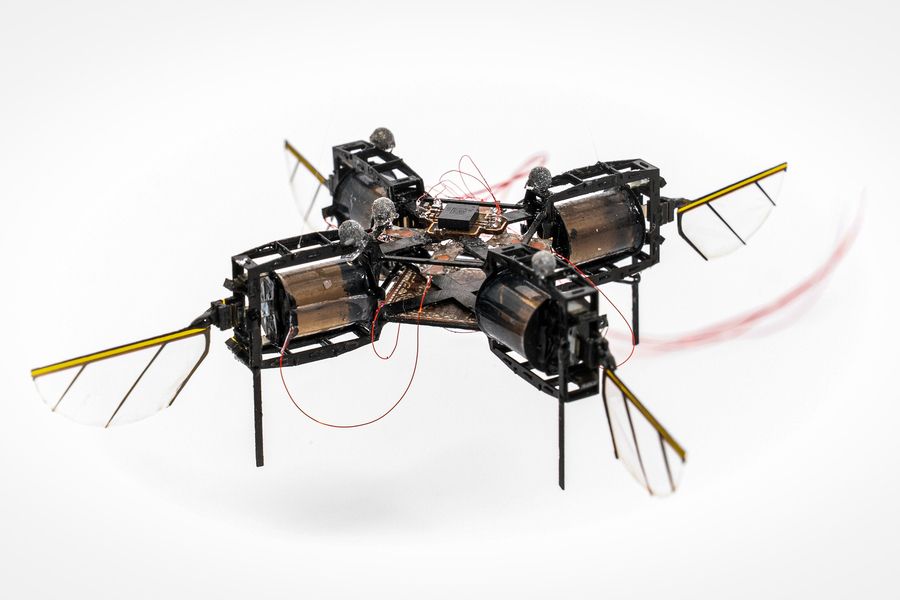
The 1.29-gram flapping-wing microrobot carries its own sensors and computer, hovering and landing on a sunflower with centimeter-level accuracy.
MIT researchers have built a flapping-wing microrobot that flies using only onboard sensors and computation, freeing featherweight flying robots from the motion-capture systems that have kept them tethered to the lab. In a demonstration outside the motion-capture environment, the robot followed complex trajectories and landed on a sunflower.
The machine is roughly the size and shape of a microcassette and weighs 1.29 grams, less than a paperclip. Four wings, each driven by a set of soft actuators that work like artificial muscles, flap rapidly to keep it aloft. To carry electronics, the team scaled up the actuators by 50 percent, boosting net lift force by 46 percent and reaching a lift-to-weight ratio of 1.9.
The 244-milligram electronics package holds the sensors and microcontroller: an inertial measurement unit to estimate attitude, an optical flow sensor for lateral speed and position, and a time-of-flight sensor for height. Without motion capture, the robot has no absolute position reference, so the team designed a fast sensing algorithm to calculate orientation, angular velocity and position, finding that continuous, faster estimates performed better than slower, more accurate ones. The result is positional accuracy of a few centimeters, comparable to flying with offboard cameras.
“This is a really important milestone for the research community. This is the first demonstration of an aerial microrobot that is sensory and compute autonomous,” said Kevin Chen, an associate professor in MIT's Department of Electrical Engineering and Computer Science and head of the Soft and Micro Robotics Laboratory. Small-scale robots, he said, are uniquely suited to jobs where a larger robot cannot go, such as pollination or industrial surveillance.
In flight tests, the robot hovered at different heights and followed point-to-point trajectories. Guided by joystick commands, it flew around several plants before landing carefully on the sunflower. The electronics consume only about 6 percent of the robot's total power, with the rest driving the artificial muscles and wings.
The robot still draws power from an offboard source and carries no camera yet. The researchers are now working to add a camera for autonomous object recognition and obstacle avoidance, and to integrate power electronics and batteries for untethered flight outdoors. The work, published in Science Robotics, points toward precision pollination in regions where natural pollinator populations have declined, as well as crop-health monitoring, pest detection and industrial surveillance.