KAIST humanoid pushes 35 kg while walking, no external cameras
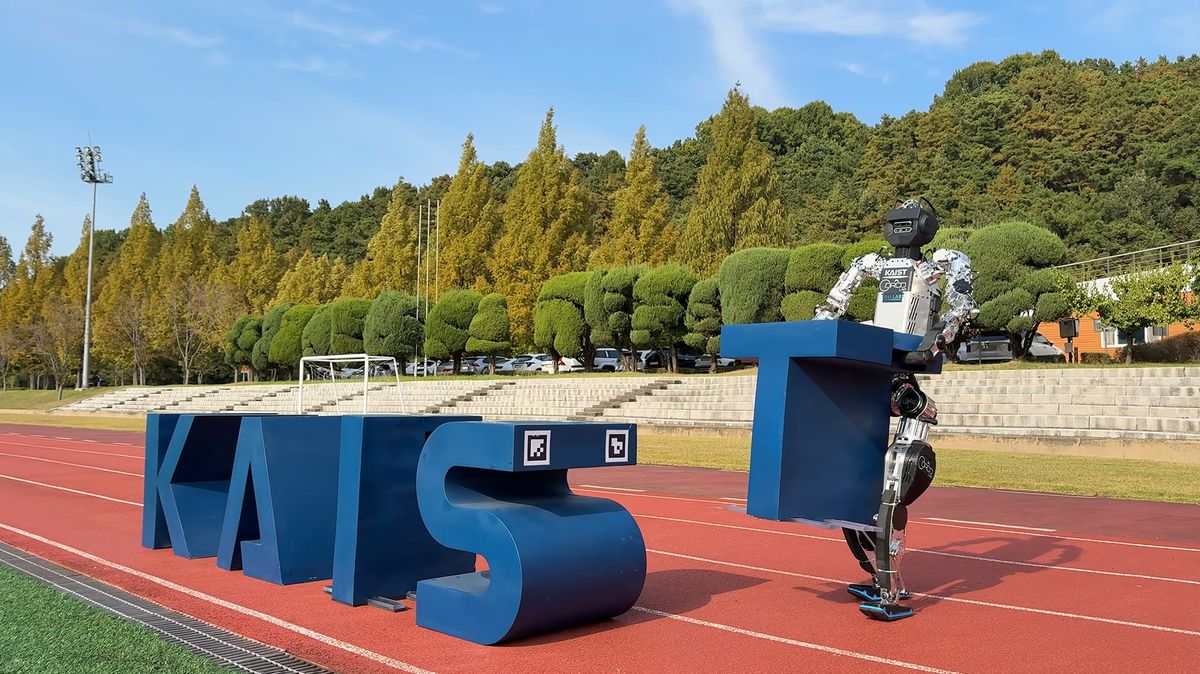
KAIST’s v0.9 humanoid pushes 35 kg and lifts 20 kg while walking on onboard vision, already clearing South Korea’s 2028 lifting target.
South Korea’s KAIST has released footage of its Humanoid v0.9 pushing objects weighing up to 35 kilograms (77 pounds) and lifting up to 20 kilograms (44 pounds) while walking — guided entirely by cameras on the robot, with no external motion capture equipment in the room.
The demonstration, titled “Whole-Body Locomanipulation with KAIST Humanoid v0.9” and published through the university’s Dynamic Robot Control and Design Laboratory on Monday, October 19, shows the robot arranging letter blocks to spell out “KAIST” — navigating, making contact and rebalancing in real time.
The 20-kilogram lifting figure matters because it already meets the benchmark South Korea’s own K-Humanoid Alliance set as its 2028 commercial readiness target. The Ministry of Trade, Industry and Energy-led consortium, launched in April 2025 with roughly 1,300 member organizations, requires lifting capacity of 20 kilograms or more for deployment readiness; a university research platform is clearing the bar more than 14 months early.
The hardware story is independence. The DRCD Lab, led by Professor Hae-Won Park, designs its core components in-house, including a quasi-direct drive actuator built around a custom 3K planetary gearbox — low-ratio joints that are naturally backdrivable and reflect contact forces transparently. The v0.9 adds upper-body capability from RAILAB, led by Associate Professor Jemin Hwangbo, and trains a unified leg-and-arm policy through the lab’s DynaFlow framework, which uses human motion-capture data as a behavioral prior instead of training purely from simulation.
Context: South Korea has committed 2.3 trillion won (about $1.73 billion) to humanoid development through 2030 and plans to purchase 250 domestically developed humanoids in 2027. What the video does not show is sustained task performance or production readiness — the letter-block task is structured and controlled. But a specific, public number is progress: 35 kg pushed, 20 kg lifted, on onboard vision.