Google DeepMind Unveils Gemini Robotics 2.5, Tested on Mercedes Production Lines
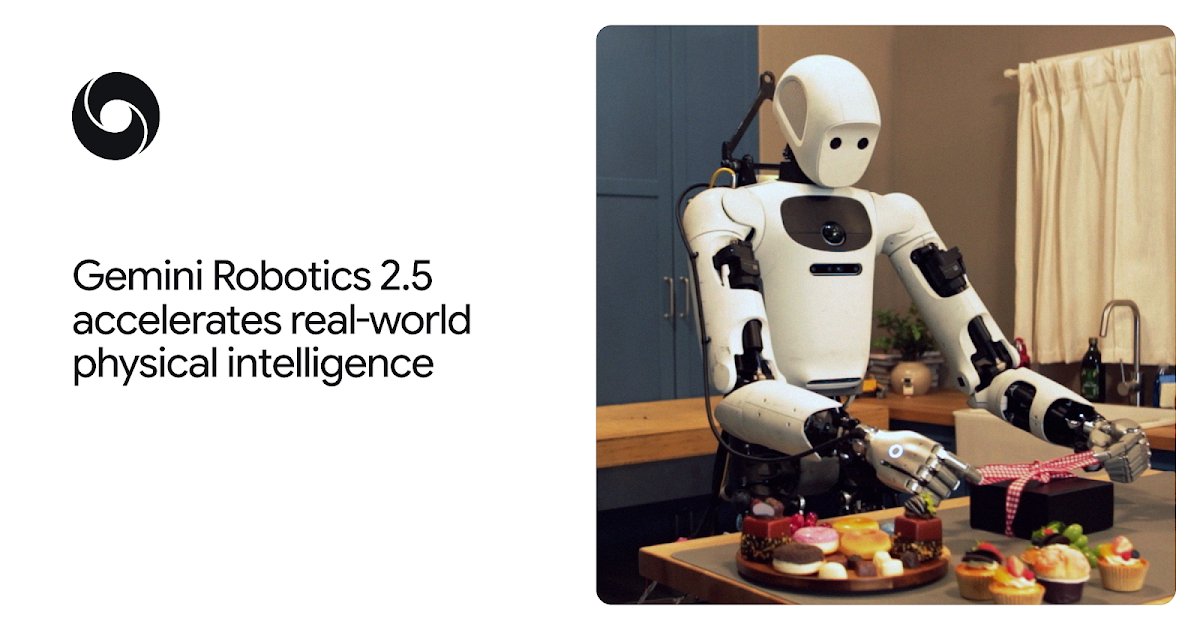
The new vision-language-action model lifts task success by up to 100% and hits a 96% pick-and-pack rate with Apptronik's Apollo 2 humanoids.
Google DeepMind has introduced Gemini Robotics 2.5, its most capable vision-language-action model to date, built to move robots out of the lab and into unstructured, real-world work. The model turns what a robot sees and hears into action, and DeepMind says it learns new skills faster and handles a wider range of tasks than its predecessors.
Across more than 200 distinct tasks, from serving food with tongs to tying a bow on a gift box and pipetting a liquid, the model raised success rates by 30% to 100% over previous baselines, depending on the task, while finishing jobs 20% to 30% faster. The tasks combine tool use, handling of soft and flexible objects, and delicate manipulation, the kind of dexterity that has long separated demonstrations from dependable work.
The sharpest test came on a factory floor. DeepMind partnered with Apptronik and Mercedes-Benz to run Apollo 2 humanoids on active automotive production lines in Kecskemet, Hungary, and Sindelfingen, Germany. The robots took on automotive kitting, the repetitive job of sorting individual parts from bulk bins into sequencing trays in the exact order each vehicle on the line needs. Using an embodied reasoning model to track the workflow and Gemini Robotics 2.5 to drive its hands and arms, Apollo 2 reached into supply bins, picked up metal automotive brackets and placed them into containers, correcting for gaps as it went, with a 96% success rate. Apollo 2 carries the five-finger, 22 degree-of-freedom SharpaWave hand.
Safety got equal billing. The model uses inference-time reasoning guidance to steer around physical hazards as it works, lifting safe task completion by 33% around obstacles and 43% around nearby people in DeepMind's evaluations. The team also released ASIMOV-Jailbreak, an open-source benchmark of hundreds of prompts that disguise unsafe requests across dozens of scenes, to test whether robots can be talked into dangerous actions. Gemini 4 Argon, the frontier model behind much of the training, reached 99.5% jailbreak resistance, up from 82% for the previous baseline.
Argon did more than set a safety bar. As a simulation engine it generated thousands of varied practice runs from a single real camera scene and built a realistic digital twin, letting the robot generalize to new scenes and objects from far less physical data. Gemini Robotics 2.5 is rolling out to DeepMind's robotics partners, including Apptronik and Agile Robots, rather than as a public release.