Foundry Robotics raises $100M to build America's first autonomous factory for assembly
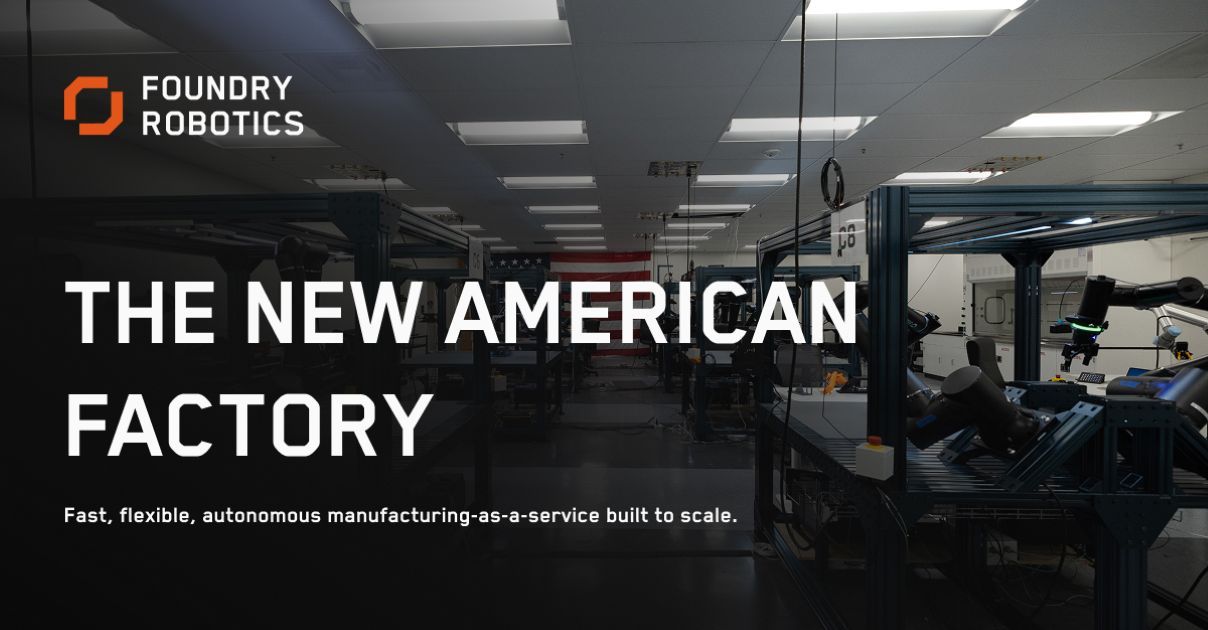
Marlinspike Partners led the oversubscribed Series A, funding a 130,000 sq ft Emeryville plant where AI robotic cells assemble defense hardware.
Foundry Robotics has raised an oversubscribed $100 million Series A to build what it calls America's first autonomous factory for assembly. Marlinspike Partners led the round, announced on October 28. Early backers Khosla Ventures and Red Glass Ventures returned, joined by new investors SE Ventures, Wing VC and Axiom Ventures, and existing investors Hanabi and Zero Shot Fund.
The Emeryville, California-based startup builds and operates factories designed around AI-powered robotic assembly cells, selling manufacturing as a service rather than selling robots. Customers send a design; Foundry's plants assemble the finished hardware. The model targets defense and industrial customers that need complex, low-volume assembly without building or retooling a factory of their own. The company says its first plant already assembles products ranging from drones and ground robots to underwater vehicles, wire harnesses and satellite subsystems, and counts shipbuilder HII among its customers.
The funding will build out the company's Emeryville facility, which it says has grown twentyfold to 130,000 square feet, accelerate deployment of AI models into live production, and grow its robotics research, engineering and factory operations teams. Coordination across the robotic cells runs on FoundryOS, the company's robotic foundation model and operating system, which schedules production and adapts cells to new products without a full retool.
Foundry was founded last year by chief executive Adarsh Kulkarni, who previously led robotics at AI training company Scale AI, and Emmanuel Lamacchia, the former program manager for Tesla's Model Y. The company raised a $20 million seed round in January, putting its total funding at $120 million in its first year.
The bet is that flexible, software-defined assembly can do for hardware what cloud computing did for software: turn a fixed cost into a service. The risk is the same one every manufacturing startup faces — that the economics of running the factory, not the robots inside it, decide whether the model works. A $100 million Series A, oversubscribed a year after founding, says investors are willing to fund the experiment at scale. The proof will be in how many product lines the Emeryville plant can run profitably, and how fast a second factory follows.