Foundation Unveils Phantom MKII, a 200-Pound Humanoid Built for Factories and the Battlefield
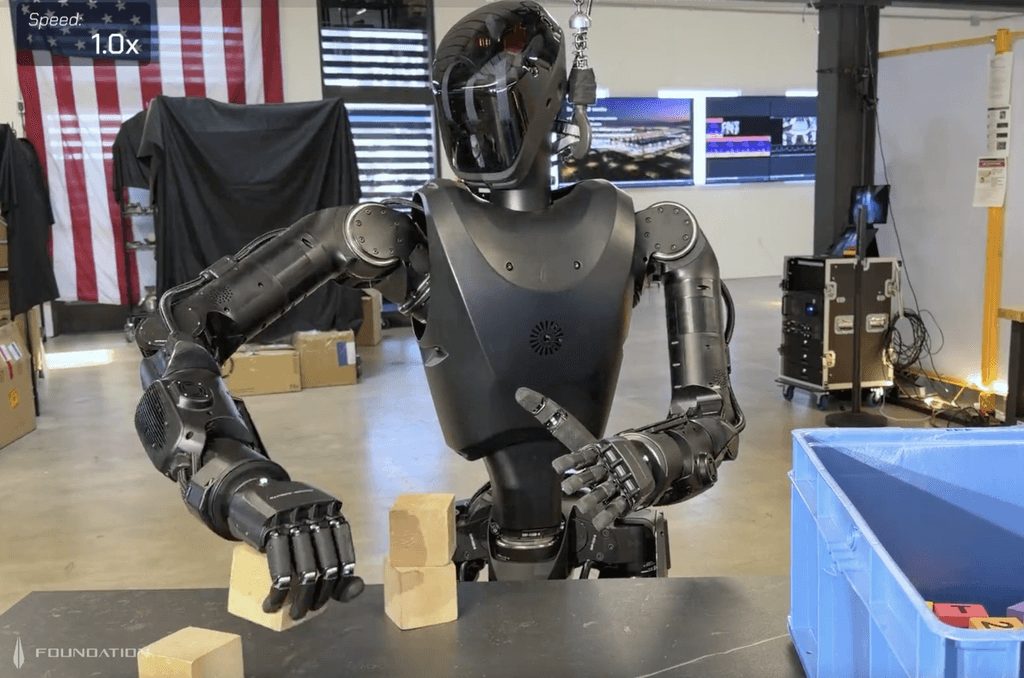
Foundation has unveiled the Phantom MKII, a humanoid that can carry 200 pounds, as its CEO says the company would arm it if the military asked.
Foundation Future Industries has unveiled the Phantom MKII, a second-generation humanoid designed for heavy industry and defense, alongside Cortex II, the artificial intelligence system that controls it. The San Francisco startup says the robot can walk while carrying 200 pounds, more than three times the load of its predecessor, and keep working through rain, snow and dust.
The hardware gains come from a redesign of the actuators, the motors and gearing that move the robot's limbs. Foundation says the joints are now about three-quarters the size of the previous generation's while delivering more than 1.5 times the performance, and that the bill of materials cost has been halved. The robot has weather-resistant joints and modular parts that can be replaced in the field, and its battery runs for up to six hours, though heavier payloads cut that figure. The company says it aims to begin producing MKII robots in early 2027, building several hundred at first and ramping to a few thousand by the end of the year, with production initially remaining in the San Francisco Bay Area.
Cortex II is built to learn physical tasks by watching people perform them, needing as few as 60 demonstrations for some tasks, the company says. Foundation sees construction sites as the robot's ideal first use, and its chief executive, Sankaet Pathak, argues in a manifesto published with the launch that fleets of humanoids working in mining, materials processing and construction could cut the cost of a $1 million home to between $60,000 and $80,000.
“We're not anti-weaponization and warfare,” Pathak said in an interview with Fast Company. “That's not something we have a blanket policy of just saying we're not going to do.” He said the company would consider arming its machines if asked to by the U.S. military, arguing that ground robots could reduce reliance on drones and air strikes. For now, he said, most of the company's defense work focuses on logistics rather than combat, though he did not rule out battlefield deployment. He is also open to the robots taking on policing roles, provided they are deployed in ways that make people feel protected rather than intimidated.
Pathak also pushed back on a Financial Times report earlier this month that Foundation's co-founder and president, Mike LeBlanc, was in direct talks with the Israel Defense Forces to supply up to 1,000 of the first-generation Phantom MK1 robots. “We're not in talks with the IDF in any official capacity on deploying robots there,” Pathak said. “What we have are very early exploration conversations.” He said there is “literally nothing actively going on” and no conversations progressing toward a contract.
The unveiling lands four days after CNBC reported that Foundation missed its October 30 payroll and that Pathak borrowed $4.6 million from the company last year to buy a home in Sausalito, California. Workers were still waiting for their pay more than two weeks after the missed payroll, and the company had also run short of payroll cash in August. Pathak has been seeking hundreds of millions of dollars at a $3 billion valuation since at least January, and the company says its next-generation robot is central to that pitch. The MKII had been previewed in a San Francisco Standard profile published November 14; Tuesday's announcement is its formal unveiling.