Boston Dynamics explains why Atlas's new hand has four fingers, not five
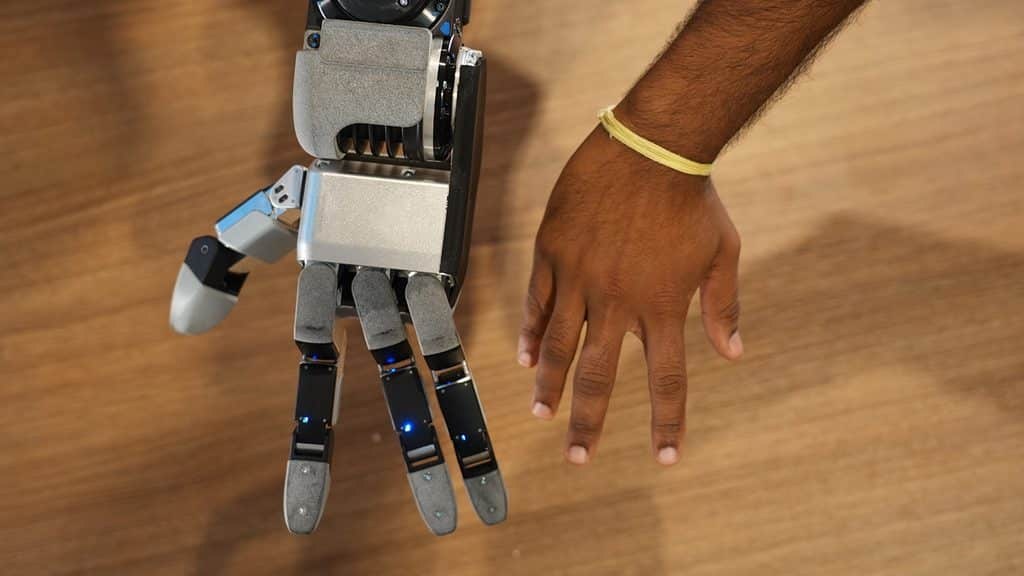
Why Atlas's new hand has four fingers: the tradeoff between dexterity, cost, and manufacturability, per Boston Dynamics.
Boston Dynamics has published the engineering reasoning behind the most conspicuous design choice on Atlas's new hand: it has four fingers, not five. In a blog post detailing the hand's development, the company frames the missing pinky not as a compromise but as the outcome of a deliberate tradeoff between dexterity, strength, ruggedness, cost, repairability, and sensing.
The new hand carries 13 degrees of freedom, nearly double the seven of its predecessor. The thumb alone has four degrees of freedom in a more anthropomorphic configuration; each of the three remaining fingers has three, arranged to allow finger splaying and full fingertip control. Where the previous hand was designed to grasp a wide variety of objects, the company says this generation is designed to manipulate them — sliding the thumb along and across the fingers, forming pinch and tripodal grasps, and operating tool triggers.
The pinky did not survive the design review. Early in the process, chief product and technology officer Zack Jackowski asked the engineering team to tape their pinky and ring fingers together for a day and report back on what they could not do. The verdict, in the company's telling: the fifth finger was not worth three more actuators plus the added cost, volume, and probability of something breaking. Four fingers and 13 degrees of freedom already unlock in-hand reorientation, recovery from slipping grasps, and tool use with trigger operation.
Just as notable is what the hand is designed for beyond hardware: simulation. The actuators are backdrivable and transparent, with a single actuator type fully encapsulated and no fragile cables crossing joints — the same philosophy as Atlas's body. Combined with control techniques that compensate for cogging and friction, the hand can be simulated with high dynamic fidelity, which makes reinforcement learning in simulation more effective. The company reports promising sim-to-real transfer on dynamic tasks, with policies trained with domain randomization and deployed relying on high-rate actuator proprioception for feedback.
Dense pressure tactile sensors blanket the fingertips and palm to pick up small contact signals, complementing proprioception. The hand is sized like a large human hand so Atlas can use human tools and reach into human-sized spaces, while keeping the strength of the previous generation — demonstrated carrying a loaded mini-refrigerator weighing more than 100 pounds.
Tool use sits at the top of the priority list. The kinematics are tuned for triggered tool grasps covering drills, power torque drivers, grinders, nail guns, and welding torches. The company's position: the ultimate general-purpose dexterous manipulator will not be an over-complicated hand, but one that is reliable and capable of using tools — tools being, in the Aristotelian framing the post invokes, multipliers that unlock the hand's possibilities.
Underlying all of it is manufacturing. The company calls the hand a long-term bet on the fight to manufacture reliable hardware at large scale and low cost — the same bet driving Atlas's deployment timeline at Hyundai's Georgia plant. If the hand works as designed, the missing pinky will be remembered as the moment Boston Dynamics chose shippability over anatomy.