Anyverse open-sources MWA-Phoenix, a 7B world model that lets robots act on video alone
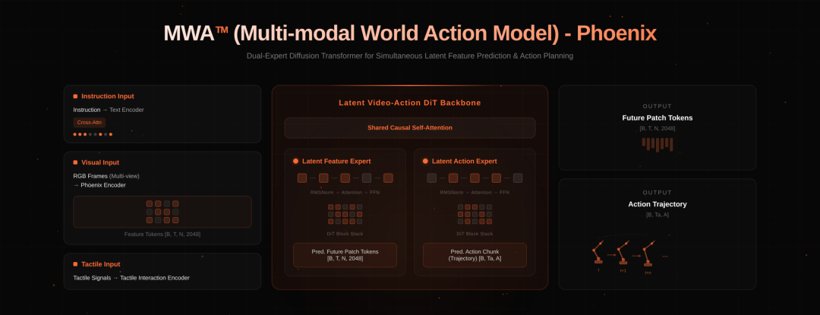
Anyverse Dynamics has open-sourced MWA-Phoenix, a 7-billion-parameter world model for robots that works from RGB video, no depth sensor needed.
Anyverse Dynamics has released and open-sourced MWA-Phoenix, a 7-billion-parameter world model built to run on robots at the edge. The model follows the MWA system the company launched in June, and it is meant to give a robot a working picture of physical cause and effect: what will happen if it moves, pushes, grasps or lets go. Notably, it works from ordinary RGB camera video alone, without a depth sensor, which matters because depth hardware adds cost, weight and failure points to real robots.
The headline numbers come from the company, and should be read that way until independent teams reproduce them. Anyverse reports leading results across six benchmarks, including a 94.63 percent overall success rate on LIBERO-Plus and 66.48 percent on LIBERO-Pro, two simulated manipulation suites. On the RoboCasa GR1 Tabletop evaluation it reports 82.67 percent, up 7.50 percentage points from its predecessor. It also reports 45.6 percent on Bench2Dex, 72.42 percent on the RoboTwin 2.0 dual-arm manipulation test, and strong results across three robot bodies and 18 tasks on the RoboDojo real-world leaderboard, which tests policies on physical hardware rather than in simulation alone.
Two companion releases arrive alongside the model, and they target the two places where robot manipulation usually breaks down: touch and practice. Phoenix-ILA co-encodes motion with tactile signals, so contact feedback feeds directly into action learning; in company tests, that lifted cucumber peeling from 20 percent to 40 percent success and plate wiping from 75 percent to 90 percent. Phoenix-PhysCanvas is an interactive simulation world model built as a playable training ground for reinforcement learning; after post-training inside it, the company says real-world test-tube and block manipulation rose from 58.33 and 80 percent to 75 and 86.67 percent.
Under the hood, MWA-Phoenix uses DINOv3 as its visual backbone, fusing geometric priors with temporal information through dual-teacher distillation, and trains environmental dynamics prediction and action generation together rather than as separate stages. Anyverse says it has accumulated more than 200,000 hours of multimodal data and is training larger versions for dexterous manipulation in commercial and industrial settings. The open-source move is the part worth watching: a capable small world model that labs can actually run and inspect lowers the bar for building on this approach, but its benchmark lead will only mean much if other teams can reproduce it on their own robots.