Waseda's AIREC Care Robot Lifts a Mannequin From Bed to Wheelchair, Unaided
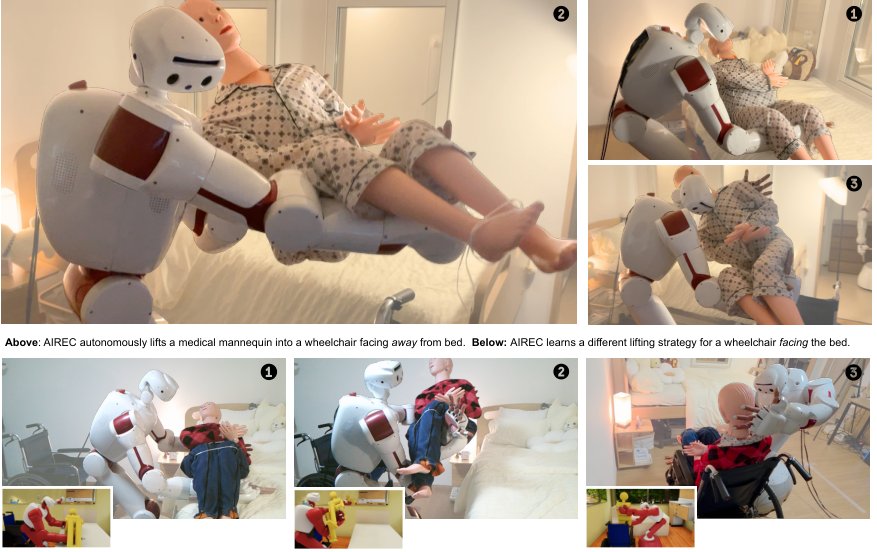
Waseda's AIREC care robot carried a 15 kg mannequin from bed to wheelchair with no human help — a first for a humanoid, trained in simulation.
Waseda University's AIREC care robot has carried a medical mannequin from a bed to a wheelchair with no human help during the move — the first time a humanoid robot has completed the full transfer unattended, the team reports. The work, titled "Into My Arms," was posted to arXiv on November 22 by researchers from the University of Edinburgh, Waseda University, Abu Dhabi's Technology Innovation Institute and Microsoft Research Asia.
AIREC, short for AI-driven Robot for Embrace and Care, is a 35-degree-of-freedom humanoid on an omnidirectional wheeled base — built for care work rather than walking. In a bedroom scene, it lifted a clothed medical mannequin, 155 cm tall and 15 kg, from a nursing bed and set it down in a wheelchair beside the bed, with no human intervention during execution. The team also showed the reverse move, wheelchair back to bed.
The transfer was learned the hard way, then replayed. The team trained the control policy entirely in simulation using structured reinforcement learning — three additions that guide exploration through whole-body, contact-rich, long-horizon tasks — then deployed the learned trajectories on the real robot with no further training. A single policy adapted across substantial variations in body mass, size and random force perturbations, and training took under an hour on a single GPU.
The authors are careful about what the demo does and does not prove. It shows physical feasibility, they write, but it is not a full closed-loop hardware validation — the same trajectory does not always succeed. The mannequin's wrists and knees were loosely bound to make the task easier, and the robot's current shoulder torque is still insufficient for a real person of around 50 kg.
The work sits inside Japan's JST Moonshot Goal 3 program, which aims for AI robots that learn, adapt and act alongside people by 2050, and builds on Waseda's earlier care-robot research with the Dry-AIREC system. Earlier machines got part of the way there — RIBA lifted a person from bed to wheelchair, and RoNA lifted a 227 kg patient — but both needed a caregiver for key parts of the job. This is the first time the whole transfer ran with no human in the loop.