Agibot unveils GO-3 robot brain, a Worken yardstick for robot output, and near-RMB 2 billion in half-year revenue
At its 2026 Innovation Day, Agibot unveiled the GO-3 Preview model, a Worken metric for robot output, and near-RMB 2 billion in first-half revenue.
Agibot used its 2026 Innovation Day in Shanghai to make a single argument: the contest in embodied AI has moved from building impressive bodies to proving what deployed robots actually produce. The company unveiled a new foundation model, a new yardstick for measuring robot output, a heavy-duty industrial robot, a dexterous-hand family, and an open-source operating system in one event, and disclosed that first-half revenue came to nearly RMB 2 billion on 9,700 robots shipped.
The centerpiece is GO-3 Preview, a new embodied foundation model built on Agibot's own WRAM architecture, which models understanding, prediction, and action in one system rather than bolting them together. The company says the model recently topped three industry benchmarks, RoboDojo, RoboTwin, and RoboColiseum, and plans to open source it fully by the end of 2026. The RoboDojo result comes from the GO-3 Nano Preview variant, which scored 61.90 with a 56.42 percent average success rate across 42 simulated and 18 real-robot tasks. Around the model, Agibot built a full learning loop: Genie Evolver, a post-training system combining around 100 real robots with simulation and a world model, and Genie Master, an agent framework meant to let robots pick up new skills while on the job rather than waiting for retraining.
The more provocative announcement is Worken, a unit Agibot proposes for pricing and judging physical AI. Worken, short for effective intelligent work hours, is calculated as active robots multiplied by autonomous working hours multiplied by an output efficiency ratio. Co-founder, president, and CTO Peng Zhihui framed it as the next in a line of productivity measures, after horsepower for steam, kilowatt-hours for electricity, and tokens for digital AI. The pitch is a business-model shift: from selling or renting robot bodies toward charging for verified useful work. That only holds if others adopt it. For now Worken is a company-proposed metric, not an industry standard, and its output efficiency ratio is defined by Agibot itself.
The commercial numbers give the pitch something to stand on. Agibot shipped 9,700 robots in the first half of 2026 and rolled its 20,000th unit off the line in September, doubling cumulative output from 10,000 to 20,000 within six months. Deployment claims are specific: 120 Genie G2 robots run security, information, and patrol tasks across Guangzhou Metro, nearly 500 robots operate across more than 100 roles at a Chimelong theme park, rising toward 1,000 by year-end, and Genie G2 units cover tablet quality inspection at Longcheer, chip loading at packaging and testing firms, and machine-tending at CNC workshops. The new Genie G2 Max is already handling industrial material-handling tasks at food, daily-chemical, fast-moving-consumer-goods, and e-commerce leaders.
The hardware stack behind those deployments got a thorough refresh. The third-generation AHA3 architecture brings EtherCAT plus 10-gigabit Ethernet buses, gallium nitride electric drives, centimeter-level multimodal positioning, and combined Wi-Fi and 5G connectivity. A first subcutaneous joint liquid-cooling system dissipates seven times as much heat as air cooling and triples sustained joint torque, while special-purpose joints rated IP67 work from minus 40 to 55 degrees Celsius. The new OmniHand 3 family spans a compact Lite model the company calls the smallest mass-produced dexterous hand, an industrial model already running continuously on production lines, an Ultra model with full tactile sensing, and the OmniPicker 3 gripper with 70 tactile points per finger. The MEgo Glove data glove captures 21 degrees of finger freedom with a palm fabric just 0.3 millimeters thick, and its Ultra version adds three-dimensional force and tactile sensing at 0.01 newton sensitivity and up to 1,000 hertz sampling.
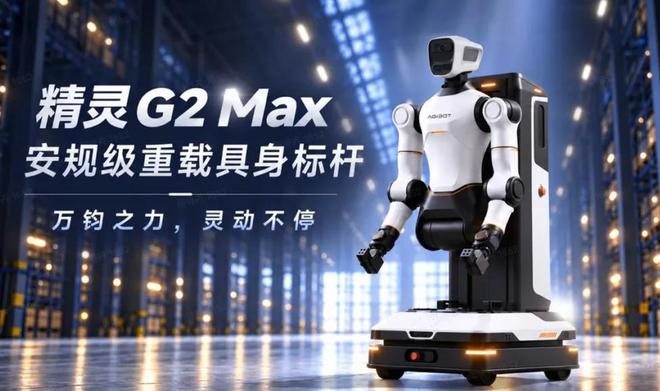
The Genie G2 Max itself is built for factories that cannot be rebuilt around a robot. Its dual arms carry 20 kilograms each, 40 kilograms combined, with a peak of 50 kilograms at sub-millimeter positioning accuracy, and a tilting waist joint lets it work flush against a wall without a turning aisle, reaching from the floor to 2.5 meters high. Full-circle perception and a safety bumper chassis meet industrial safety standards, hot-swappable dual batteries support round-the-clock operation, and the Genie Studio 2.0 platform compresses new-scenario deployment to as little as seven days. It is already running on a joint production line at a 2.5-minute takt, matching the pace of the line it feeds.
Two software releases round out the day. WITA Omni 1.0 is a multimodal interaction model that takes voice, vision, and text in and produces voice, expression, and motion out, listening, thinking, and speaking at the same time, with support for more than 100 languages and 29 dialects and a face display that visualizes what the robot is thinking. It opens to first friendly customers now, with a domestic rollout in December, a European debut in January 2027, and a wider overseas launch in March. Lingqu OS 1.0, described as the first embodied-AI-native operating system, is open sourced and donated to the OpenAtom Foundation as the base of a shared robotics software ecosystem. A 2026 embodied intelligence industry innovation report, compiled with Xinhua's China Economic Information Service and the China Academy of Information and Communications Technology, was released at the same event.
The breadth is the story, and also the caveat. Few robotics companies can announce a model, a metric, an operating system, a hand family, and a heavy lifter in one morning. But the benchmark crowns and the Worken formula are company claims awaiting independent validation, and the deployment figures are company counts, not audited results. What can be checked is the direction: Agibot is betting that the next phase of the race is won not by the most theatrical robot, but by the one whose working hours can be counted, priced, and repeated on a real production line.