ACE Robotics' ACE-CaP-0 Turns Robot Skills Into Reusable Code
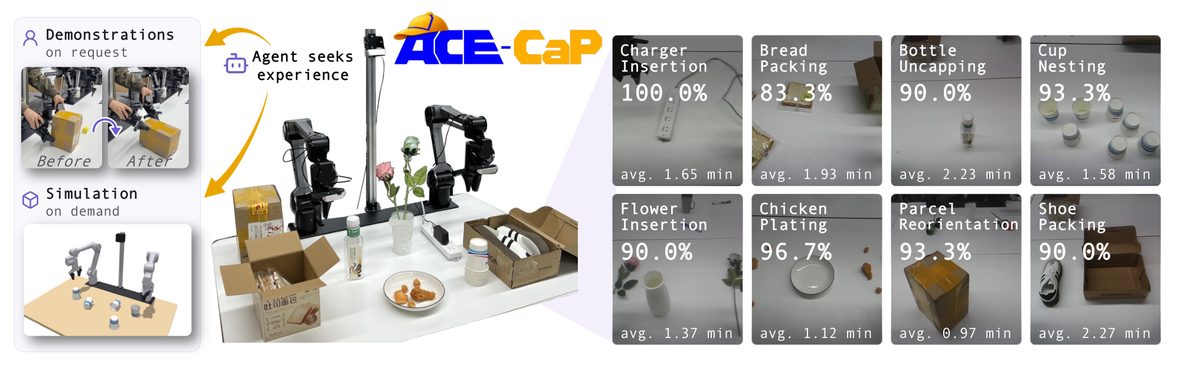
ACE Robotics' ACE-CaP-0 freezes AI-written robot skills into standalone programs that scored 92.1% across 240 real-world trials.
ACE Robotics has released ACE-CaP-0, a method that lets a coding agent develop robot skills through experience and freeze them into standalone programs that run without further help from the model. The work is published as arXiv paper 2611.16872, posted on November 12, with a project page showing the system at work.
The idea is Code as Policies: robot behavior written as executable programs, so the reasoning invested during development is kept and reused instead of starting over on every run. The problem it attacks is the cost of calling a frontier model for every decision, where inference latency piles up and each attempt begins from scratch. ACE-CaP-0 moves the model's work to development time. The agent writes code, tests it on the robot, asks for a human demonstration when it gets stuck, and runs simulations to compare revisions. Once a program works, it is frozen and executes with runtime perception and control, with no human or coding agent in the loop.
The team tested the recipe on eight real-world manipulation tasks on a dual-arm setup: charger insertion, bread packing, bottle uncapping, cup nesting, flower insertion, chicken plating, parcel reorientation and shoe packing. The frozen programs succeeded in 221 of 240 trials, a 92.1% success rate, with 30 trials per task. Mean execution times ran from 0.97 to 2.27 minutes per task. Charger insertion scored a perfect 100%, while bread packing was the weakest at 83.3%.
The development study behind the recipe is the more telling part. On charger insertion, demonstrations provided on request reached 86.7% final success, against 53.3% when the same guidance was handed over upfront, and cut development time from 7.2 to 3.7 hours. Adding simulation on demand pushed the charger program to 100%, against 86.7% without simulation, in 2.6 hours. For charger insertion, the frozen program averaged 1.65 minutes per run; a general-purpose model reasoning through the same task directly needed roughly an hour of trial and error to settle on a working strategy, the team reports.
The team frames the work as a step toward embodied recursive self-improvement: robots accumulating executable skills instead of re-deriving them on every run. It also flags the open questions. Whether separate development runs reliably produce equally capable programs is still untested, as is how well the frozen skills transfer to new environments. ACE Robotics has been building out an embodied-AI stack this year, including the ACE-Brain-0.6 foundation model and the Mundo world model developed with NTU's S-Lab.