DexForce's UNITAS unifies robot action and world prediction in one 3D frame
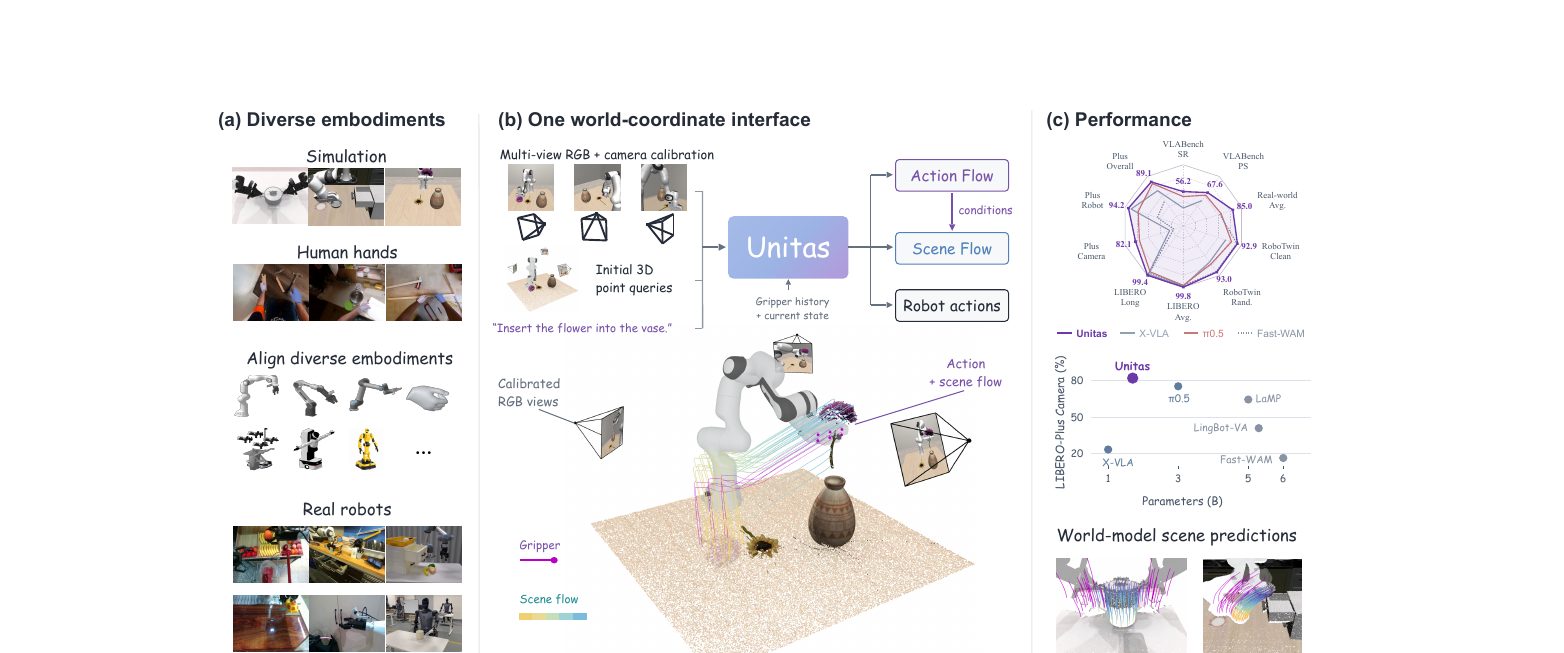
The 1.7B-parameter world action model scores 99.8% on LIBERO and predicts how scenes change in metric 3D; the code is now open-source.
A team spanning DexForce Technology and CUHK-Shenzhen has released UNITAS, a 3D-native world action model for embodied manipulation. Described in a paper posted October 8 and with its code now public on GitHub, the 1.7-billion-parameter model unifies observations, actions, and scene dynamics inside a single metric 3D frame — one shared representation across different robot bodies and human hands alike.
The core idea is a break from video-generator-based world models. Most existing approaches predict future frames or visual latents, but images are view-dependent projections: pixel distances don't encode physical distances. UNITAS instead represents both human hands and robot grippers as 3D point trajectories ("action flow") and describes how scene points move in response ("scene flow"), with world-aligned 3D positional embeddings grounding every visual token and a physical-time tokenizer compressing each trajectory into one token.
The same interface serves two jobs. In policy mode it generates executable robot actions directly; in simulator mode it predicts how the scene will change given an action — a planner can ask "what happens if I move like this" before committing. Reported results include 99.8% success on the LIBERO manipulation benchmark, an 85% average across real-world tasks, and the best action-conditioned scene prediction on RoboTwin, with up to 49% lower displacement errors than the PointWorld baseline.
The honest caveat is scope: these are the authors' numbers, on benchmarks the field knows how to game, and the checkpoints and training code are still marked "coming soon" in the repository. But the direction is notable. If manipulation policies are going to generalize across the zoo of robot hardware, reasoning in meters rather than pixels is arguably where the representation had to end up.