Schaeffler opens Taicang factory where humanoids build robot parts
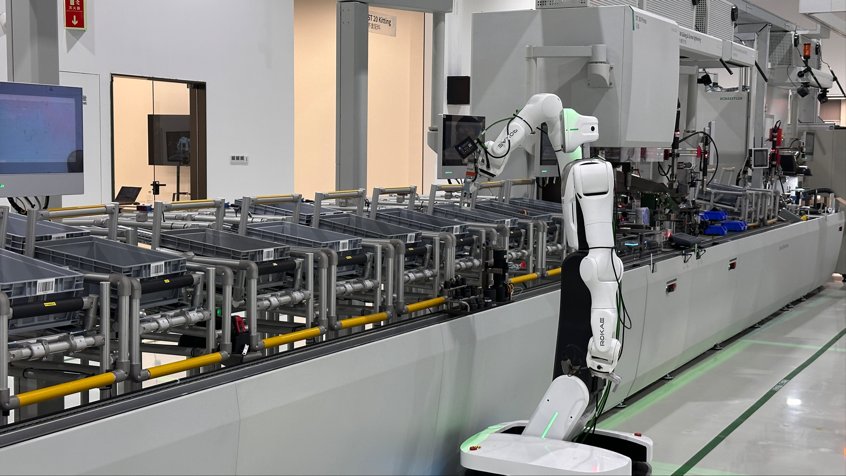
Schaeffler's 7,500 sq m Taicang plant puts six humanoids on a joint-module line, marking the start of mass production of key robot components.
German supplier Schaeffler has opened a 7,500-square-meter factory in Taicang, China, where humanoid robots assemble the components that go into other humanoid robots. The company calls it a “lighthouse factory” that combines component manufacturing, robot training, data collection and digital twins under one roof. The opening was announced on October 20.
Six humanoids work across five assembly stations on a line producing joint modules, including the linear and rotary actuators that let robots move. The robots sort parts, join components, and handle inspection, labelling and packaging. Schaeffler said the opening marks the start of mass production of these components at the site.
“We are creating something that has never before been seen in Schaeffler's global network: a closed manufacturing loop where humanoids assemble components for humanoids,” said Jochen Schröder, the company's chief operating officer.
The site also houses a training and data-acquisition centre modelled on conditions across Schaeffler's roughly 100 plants — visual inspection, material handling, container movement and replenishing production lines — which customers and partners can use to train and test physical AI systems under industrial conditions. A digital twin mirrors the line in real time, with sensors tracking assembly accuracy, task duration, energy use and equipment condition.
The commercial signal is concrete: Schaeffler said two new customers in Greater China, added in the third quarter of 2026, helped bring its global incoming humanoid-robotics orders to approximately 400 million euros. The announcement does not name those customers, and it discloses no production rate, robot intervention requirements or quantified productivity gains — the numbers that will decide how far this model scales.