Benewake aims NOVA20 near-field LiDAR at embodied robots
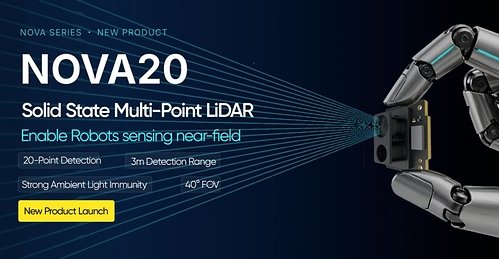
The sub-5-gram solid-state sensor maps the 5 cm-to-1 m zone around a robot's body for pre-contact safety.
Benewake has introduced a near-field LiDAR aimed at giving embodied robots a dedicated proximity-sensing layer for safer physical interaction. The NOVA20, a solid-state multi-point sensor announced in Beijing on October 13, delivers real-time distance measurements across the 5 cm-to-1 m zone around a robot's body.
The sensor is positioned to fill a gap between contact sensing and longer-range perception. Tactile sensors working within 5 cm react only after contact, while head- and torso-mounted cameras can be blocked by the robot's own limbs, leaving blind zones around its sides and lower body. NOVA20 targets the space between — the close-range motion where collisions begin.
The unit weighs less than 5 grams and draws less than 1 watt, with a solid-state design meant to mount on chests, wrists, ankles and other points around the body. A 20-point detection array with a 40-degree field of view covers the target range, and the company says ranging stays stable under ambient light up to 100 klux for outdoor operation.
To avoid false readings, the sensor uses time-division multiplexing with channel-by-channel readout, so each echo lands in its own channel and crosstalk from reflective surfaces is suppressed. The device outputs physical distance data rather than images, which Benewake says reduces vision-processing load and eases privacy concerns in human-centric settings.
Benewake frames the core uses as drop-off detection near a robot's feet, collision avoidance around moving limbs and body sides, and proximity-safety inputs for pre-contact deceleration strategies. The company, founded in 2015, says it has shipped more than 3 million LiDAR units to customers in over 90 countries.