AWS launches open-source Physical AI Toolchain, and humanoid robots are a first-class target
Amazon Web Services has released an open-source stack that bundles architecture guidance, deployment automation, and ready-to-use code for building machines that perceive, reason, and act in the physical world.
Amazon Web Services on Thursday launched the Physical AI Toolchain on AWS, an open-source stack that combines architecture guidance, deployment automation, and ready-to-use code for building machines that perceive, reason, and act in the real world. The toolchain pairs AWS services with NVIDIA's physical AI software stack and spans five pillars: synthetic data generation, model training, simulation and validation, edge deployment, and continuous improvement.
The stack is purpose-built for three domains: industrial automation, autonomous mobility, and humanoid robotics. AWS built it, AWS Industries vice president Uwem Ukpong said, because customers reported that too much of their engineering effort was going into infrastructure instead of innovation. Amazon brings unusual credibility to the claim: it says more than a million robots operate across its network, handling millions of packages a day alongside hundreds of thousands of employees, and Amazon Robotics unveiled its next-generation autonomous Proteus robot earlier this summer.
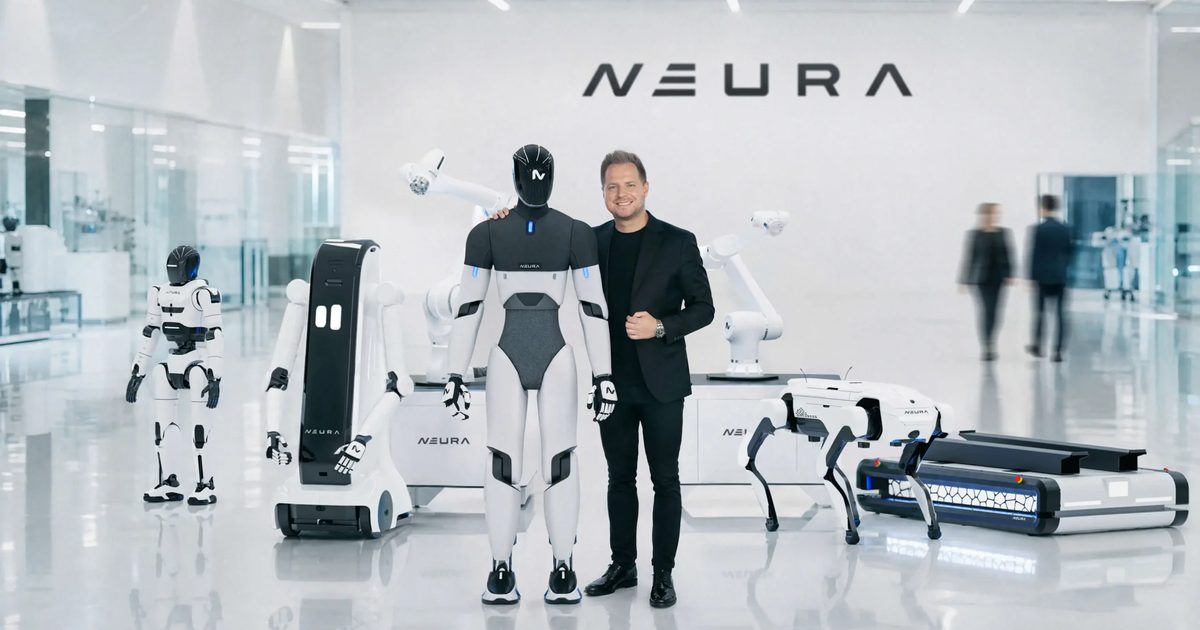
Among the early users Amazon named is NEURA Robotics, the German company developing cognitive humanoid robots. Founder and chief executive David Reger said the toolchain helps accelerate the cycle from learning to real-world deployment and ultimately to scaling physical AI globally. RLWRLD is tackling dexterous manipulation with an 8.1-billion-parameter foundation model for robotic hands, while Config has built a data pipeline capturing more than 200,000 hours of robot action data.
The toolchain also includes fleet-management capabilities for provisioning, securing, and updating thousands of machines over the air — the unglamorous bridge between a working prototype and production at scale. Amit Goel, NVIDIA's head of the robotics developer ecosystem and edge AI products, framed the stack as an end-to-end workflow covering training, simulation, and deployment on a single control plane.
The timing is no accident. Amazon's Global Startup Trends Report on physical AI found that one in seven startups globally is now building physical AI, and 72% of those builders say cloud computing is essential to their systems. And the toolchain is not a straight revival of RoboMaker, the cloud robotics simulation platform AWS shut down in 2025: Sri Elaprolu, director of Frontier AI Science and Engineering at AWS, told The Robot Report the new stack covers a broader set of development technologies than its predecessor.